Sunday, 13 August 1995

MADAGASCAR August 1995 (part 1)

The following blog relates to a trip done with John Cooper, Nick Preston and Barry Stidolph.  John's more detailed and better illustrated report of the same trip, including photos of some identifiable birds(!!), can be found at http://jfcbirdingtrips.blogspot.co.uk/2012_06_01_archive.html.

Barry arrived in Madagascar two days before the rest of us and his earlier arrival enabled him to start negotiations with tour firm Aventour who had not replied to faxes or letters sent from the UK.  We ended up hiring a saloon car and driver for just over 3 weeks plus 3 internal flights at a cost of approximately £650 each which we considered rather expensive.  The Aeroflot flight cost about £500 (half the price of Air France and we touched down at Mahe) and we spent another £250 each on food, petrol, accommodation, guides and boat hire.  Another British group (Jeff Blincow, Nigel Goodgame and Mark Piper) were in Madagascar at the same time (we went out and back on the same Aeroflot flights).  They visited all the same sites and had a 4WD vehicle, driver and courier.  Their trip was significantly more expensive than ours but was less hassle to organise from the UK and they did see more birds than we did, in particular by booking in advance they were able to spend longer at Ambanizana, our options there being restricted by reduced flight availability. 


Birding in Madagascar is brilliant.  The reserves are good with good systems of trails and excellent and very knowledgeable English-speaking bird guides.  The accommodation is basic (camping the only real option in some places) and the roads bad, although we got everywhere we wanted in a saloon car (fairly cosy for 4 + driver).  For someone with two young children I found the poverty in places quite upsetting.


1 August.  We flew with Aeroflot from Heathrow to Moscow where we had some initial consternation that none of the departure boards mentioned our onward flight to Antanarivo but we checked all the gates until we found it.


2 August.  We flew from Moscow to Antananarivo with stops at Dubhai and at Mahe in the Seychelles.  Here 25 White-tailed Tropicbirds were flying around the cliff face above the terminal building which got the trip off to a brilliant start.  We arrived in Antananarivo mid afternoon, were met by Barry Stidolph and went to Aventour with whom Barry had started negotiations to sort out travel arrangements (they had not replied to faxes or letters sent from the UK).  We decided to include a visit to Ambanizana for Helmet Vanga, very much at Barry's insistence, but flight irregularity allowed either 2 or 6 days there (4 would have been ideal).  We opted for the former but as it turned out the latter would have been better.  Aventour provided a package of 3 internal flights (to and from Maroantsetra and returning from Tulear) and a car and driver (Renault 20 and Terry).    It transpired that it was Terry's car and Aventour were subcontractors.  We paid 4,000 French Francs a week and petrol which we thought quite pricey for an old Renualt 20.  Terry paid for his food and accommodation although we fed him fairly regularly ourselves.  We felt if we'd had time we might have done better by arranging a 'private' charter with a taxi driver but the car was fine, if a little squashed, for driver plus four of us and luggage which was our main concern.  Once sorted and with the majority of the payment made we drove the 120 kms to Perinet as it was getting dark.  It was one of Madagascar’s better roads and took under 3 hours.  There we stayed in chalets at the Hotel Fion Nyala.
Mahe Airport, White-tailed Tropicbirds on the cliffs behind
our Aeroflot plane
Mahe runway
leaving Mahe
driving in to Antananarivo
3 August.  We were up at dawn, in Madagascar and full of expectation.  We moved our stuff to the rather old and a bit seedy Hotel de la Gare (the better Nyala was full, but it made little difference to us as we were out most of the day) and soon engaged recommended local guide Patrice for two days.  The main advantage of being in Madagascar earlier than most birding trips (October/November is recognised as the best time) was that the best bird guides were less likely to be booked.  Patrice had his own tapes of bird songs and was very sharp.  He took us around his ‘normal’ circuit seeing 36 new birds and several Lemurs including an Indri.  The trails at Perinet were very good and easy to follow but we were told that visitors were not allowed in the forest without a guide, although this may have been a ruse on their part.  In any event we were very pleased to have Patrice with us.  Highlights were brilliant views of Short-legged Ground Roller, Cuckoo Roller, 6 Vangas and our only Red-fronted Coua, Madagascar Little Grebe (on the lake near our chalets) and Dark Newtonias of trip.
 
Nick outside the Fion Nyala chalets
Lake at Perinet, we saw our only Madagascar Little Grebe here
John on a bridge at Perinet
a colouful chameleon


4 August.  We were guided again by Patrice, spending an excellent morning at Maromiza which was at a higher elevation.  In the afternoon we visited some marshes 16km east of Moramanga where we heard but could not see Madagascar Rail.  We returned to Perinet in the evening and wandering around seeing little in the rain.  I saw 45 species, the highlights being brilliant views of Rufous-headed Ground Roller, male Velvet Asity, Brown Emutail and Forest Rock Thrush (all at Maromiza).  Frustratingly I nearly trod on a calling flufftail without seeing it and we had no luck with Collared Nightjar.  Another night at Hotel de la Gare.
views from Maromiza


5 August.  We returned to Antananarivo making a brief stop at the marshes near Maromiza on the way but we failed to even hear the rail.  Terry dropped us off at the airport and we flew to Maroantsetra arriving early afternoon.  The very unimpressive terminal building there did not even have a road leading to it.  This rather set the standard for the town, as we found when we got a taxi into it.  We stayed at the inappropriately named Hotel Coco Beach (the recommended Hotel Tropical being closed) and found (non-birding) guide Augustine who arranged for a boat to take us to Ambanizana on the notoriously wet Masoala Peninsular the following morning and helped us buy food for our visit.  Fortunately a woman in the village there would cook it for us.  I saw just 16 species missing probably the best, the only Mellor’s Ducks of the trip, 2 seen flying over by Barry and John.  Highlights were a Madagascar Malachite Kingfisher at Perinet and a Striped Tenrec by the chalets at Coco Beach.
Maroantsetra Airport Terminal Building!
6 August.  Our boat left soon after dawn arriving at Ambanizana after an uncomfortably choppy three hour crossing (it could have been longer if it had been a full moon and stronger tides).  The early start was essential as the wind picks up during day making boat journeys across the bay more dangerous and ours felt risky enough as it was, especially as the boat had no safety or communications equipment.  I was very pleased and, with memories of being adrift off Sorong in 1993 fresh in my mind, quite relieved to arrive.  After putting up tents in a compound in the small village, and Augustine arranging a local woman to cook food for us, we headed for the main trail up into the hills.  We spent the rest of the day on the muddy trail, which climbed steeply up and along a ridge, but despite reasonable weather initially we saw very little and heavy rain in the afternoon and evening did not help.  Another day with just 16 species seen but they included a brilliant Madagascar Pygmy Kingfisher and a superbly disapproving rufous Madagascar Scops Owl spotlighted in the compound after dark.
passing Nosy Mangabe
arrival at Ambanizana
our boat
7 August.  We spent most of day on main trail at Ambanizana finishing in the clearing by compound.  It was raining heavily for most of the day but despite the weather I saw 36 species with obvious highlights being 3 Helmet and 3 Rufous and a White-headed Vanga in a mixed bird flock along the ridge in the rain.  John had bashed his toe which had swollen up making walking painful and he didn’t come out initially.  This caused us some consternation when we found the Helmet Vangas and we were about to return to let him know when he appeared coming up the trial, not having left much later than us after all.  We all enjoyed good views before they moved off.  Not a bird any of us had wanted to miss or really expected to see before arriving in Madagascar.  We were very grateful for Barry’s insistence in visiting Ambanizana to try for them.  Another night camping in the compound and a test on the waterproofness of our tents – we later learned that there was a chalet in the village that we could have arranged the use of through the Coco Beach Hotel in Maroantsetra!
heading to the forest trail
views from the forest trail during a pleasant break in the weather


8 August.  Better weather and an early morning around the clearing at Ambanizana prior to getting our boat back to Maroantsetra before the wind picked up.  Another choppy crossing and we were pleased when it was over.  We stayed around the Coco Beach Hotel for the rest of the day as there was little else to do.  Ideally we would have liked longer at Ambanizana but flight availability did not allow it.  In hindsight we should have made more of an effort to get a bird guide, little did we know how good they could be.  Scaly Ground Roller would have to wait for another time.  I saw 31 species, but with no new birds my highlight was a pair of Nelcourvi Weavers building a nest.
leaving Ambanizana


rainbow at sea
back past Nosy Mangabe
9 August.  More kicking of heels around the Coco Beach Hotel hoping the Mellor’s Duck might fly over again but they did not and Madagascar Malachite Kingfisher and Chabert’s Vanga were the most notable sightings.  We returned to the airport to catching the midday flight to Antananarivo.  The weather had closed in a bit and it had to make a couple of passes before putting down.  Perhaps we should have spent another night at Ambanizana but we did not want risk a delay causing us to miss the flight and mess up the rest of the trip.  Back in Antananarivo we stayed in the Hotel Rose and went to a nearby café to eat.  After waiting an hour for our ordered spaghetti bolognaise Barry nipped next door and came back with armfuls of baguettes to keep us going.  When the spaghetti finally arrived it was lukewarm, pity we’d not gone for baguettes from the outset.
leaving Maroantsetra
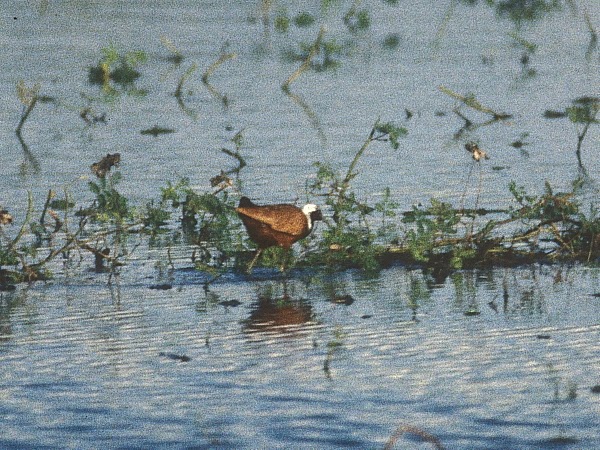
10 August.  Terry arrived on time and we left Antananarivo at 03:00 driving north to Ampijoroa.  The road was very spectacular, over the spine of the country, but dirt in many places making it a long drive.  We had a few stops on the way seeing Madagascar Harrier Hawks and Grey-headed Lovebirds but much of the drive was birdless.  We arrived at Ampijoroa Forest Station near Lac Ravelobe at 13:00, pitched our tents as there was no accommodation available and arranged for Charles, one of the rangers, to guide us for our stay.  We visited marshes 17-20 kms along the main road to the north, returning to the Lac Ravelobe for dusk.  There was a small café a short drive away that was to become our regular eatery.  Just as well as the only shop in the local village did not appear to sell anything we considered to be edible!  I saw 35 species including 5 Madagascar Jacanas (on the marsh), the pair of Madagascar Fish Eagles (with a downy youngster on a nest by Lac Ravelobe), 30 African Pygmy Geese and at dusk 8 Madagascar Nightjars.  A family of 6 Coquerel’s Sifakas, including a mother with baby, entertained us around the campsite.
dawn breaking on the Central Plateau


it appeared to be a fairly desolate habitat, presumably cleared of trees but with no Madagascan species able to take advantage of  impoverished grassland
Coquerel's Sifaka near the campsite at Ampijoroa


Madagascar Jacana north of Ampijoroa

Madagascar Malachite Kingfisher, quite like ours from behind
not so much from the front
Lac Ravelobe
11 August.  We spent all day at Ampijoroa, the morning on the grid trails on the plateau to the west of the Forst Station, midday at the shore of Lac Ravelobe and the late afternoon on ‘trail B’ to the north of the lake.  We were guided morning and late afternoon by Charles who knew the area and birds very well.  A superb day in dry forest with, unsurprisingly no rain, and just over 50 species seen.  The many highlights included two groups of White-breasted Mesites (the first, of three birds at the end of the grid trails, got highly excited in response to tape playback), Madagascar Crested Ibis (two pairs on the grid trails and a single on trail B), Madagascar Sandgrouse (a pair near the lake edge), Madagascar Buttonquail (easy to see at this site), White-throated Rail (a pair by the lake shore at dusk), 2 Coquerel’s and 3 Red-capped Couas and 9 Sickle-billed and 2 pairs of Van Dam’s Vangas.  Also 4 Coquerel’s Sifakas and 8 Brown and a Fat-tailed Dwarf Lemur.  Another night camping at the forest station with a Madagascar Scops Owl spotlighted after dark.  The ground was a bit hard but it was nice not to have any rain to contend with.
dry forest at Ampijoroa


chameleon at Ampijoroa


Fat-tailed Dwarf Lemur peering out of the bottom of the hole 
Madagascar Magpie Robin
Madagascar Sandgrouse


12 August.  Another enjoyable dry day at Ampijoroa, mostly on trail B, guided morning and late afternoon by Charles although not quite up to yesterday’s standard.  For me highlights of the 36 species seen were 3 White-breasted Mesites, another pair of Madagascar Crested Ibis, 2 non-adult male Schlegel's Asities and 20 Sickle-billed Vangas and of course the 4 Coquerel’s Sifakas.
Lac Ravelobe
Lac Ravelobe at dusk
13 August.  For our final morning we returned to trail B.  We were keen to see a male Schlegel’s Asity and after some searching Charles located a pair that gave excellent views.  Stunning birds that brought to an end a very enjoyable three day stay.  At 09:30 we said goodbye to the Madagascar Fish Eagle and its chick and left for the drive back to Antananarivo.  We arrived at 18:15 after another good piece of driving by Terry and again nowhere that seemed worth stopping on the way with nothing of note seen from the car.  I saw 30 species including the excellent pair of Schlegel's Asities, 2 Coquerel’s Couas and 10 African Pygmy Geese.
crossing the Central Plateau on our return to Antananarivo


local traders in one of the roadside villages


Tuesday, 24 August 1993

IRIAN JAYA August 1993: Arfaks and Batanta

12 August.  Back at the airport for our delayed flight to Manokwari and things were getting fraught with that day’s departures already fully booked and no immediate sign that the only plane had been fixed.  After further delays we were put on the first flight, apparently benefiting from a ‘tourists first policy’ introduced by the government.  It was the sort of thing that would cause outrage in the UK but something we were unashamedly thankful for.  We arrived in Manokwari, made our way to the local WWF Office to find our ex-pat contact, who we’d written to in advance, had tragically died.  His replacement was absolutely brilliant in contacting a guide to put together an Arfak Trek for us at short notice.  It was a complete blur to me but we got food, porters and a vehicle to drop us in Wamare in time to walk for a couple of hours to the forest edge below Inat Beab where we camped.  Few birds were seen, the best being Papuan Hornbill and Variable Pitohoui.

13 August.  We slowly walked up to Ciroubrei where we camped.  It was a fairly easy day in lowland and sub-montane forest during which half of the 22 species I saw were new.  Highlights were the immaculate Dwarf Whistler, Black-chinned Robin, Frilled and Golden Monarchs and Lesser BoP.

14 August.  From Ciroubrei at 1000m in altitude we had the option of diverting to the village of Mokwam in the hope of finding bird guide Seth Wonger who lived there.  We had not been able to contact Seth in advance and Mokwam was quite a detour, including losing precious altitude before regaining it, so we decided our limited time would be better spent higher up in the Arfaks.  In hindsight this would only have been a good move if Seth hadn’t been around.  We climbed steeply for 3-4 hours up to Gunung Umsini.  For me it was probably the toughest day of the trip being a very steep climb on a muddy trail.  Birding was particularly tough, and often I’d fall behind the others, see them stopped to look at something and it would be gone by the time I caught up.  The rest of the day was spent on the ridge trail and around Bini Bei where we camped.  A tough day but some excellent birds seen including Black Sicklebill, Magnificent BoP (although sadly only a female), Tit Berrypecker and Cinnamon-browed Melidectes.


 15 August.  All day along the ridge from Gunuing Umsini as far as Gunung Ngribbou and in the Bini Bei area, much of the time on my own.  Best birds I saw included Garnet and Ashy Robins, White-breasted Fruit-Dove, Vogelkop Bowerbird, Black Sicklebill and Western Parotia (again sadly just females).

coastal view from the Arfaks
 16 August.  A long day.  It started with a return to Gunung Umsini then much of the morning walking along the ridge to Gunung Ngribbou and back before the steep walk down to the road at Tana Mera.  Here it didn’t take long to get a bemo back to to Manokwari where we paid our guide and porters, checked into a hotel (Losmen Mulia) for two nights and went for a meal with the WWF guy.  Highlights to day were White-faced and Ashy Robins, Mottled Whistler, Black Pitohoui, Vogelkpop and Flame Bowerbirds, male Superb BoP and female Western Parotias.  I found the Arfaks particularly tough.  We probably should have spent longer up there and would definitely benefitted from having a bird guide.  Although I saw lots of good birds some of the best were only females (Magnificent BoP, Western Parotia) or brief views (Flame Bowerbirds).  I also missed a lot seen by others, much more than on the rest of the trip together.  The most painful of these were Green-backed Robin (Nick was next to me watching this one but by the time he’d stopped telling me how good it looked and started on directions it had moved out of sight – I’ve never let him forget that!), Spotted Jewel-Babbler (fortunately Nick was on his own for this one as a closer miss would have been too hard to take), Long-tailed Paradigalla (Barry) and Lesser Ground Robin.

similar view to above but clear


lower forest 
17-18 August.  We had a day trip to Warkapi, an area of lowland rainforest about two hours along the coast from Manokwari.  We knew this was where Birdquest had seen King Bird of Paradise and we managed to find the guide they used.  Hopes were high but it was to prove a very frustrating experience.  It was hot and birding was slow.  We tracked down a calling Yellow-billed Kingfisher but failed to see it despite spending over an hour peering from all angles into the tree it was sitting tight in.  What a wind-up!  On the way back I stumbled into a pair of Blue Jewel Babblers by the trail.  Brilliant, but unfortunately only Garry, who was directly behind me at the time, got onto them before they slipped away.  Nick, just behind, took this particularly hard, as I would have done in his position as Jewel Babblers are stunning birds.  To add insult to injury I then saw a Magnificent Riflebird that no-one else got onto, although it was only a female.  Other birds seen included Ornate Fruit-Doves, Rufous-bellied Kookaburra, Lowland Peltops, Glossy-mantled Manucode and female Lesser BoPs.  Back in Manokwari we were told that the fortnightly overnight ferry to Sorong was scheduled to depart the following evening.  This seemed a much more certain option that the following day’s Biak-Manokwari-Sorong flight, a route/plane that we’d already had issues with.  Plus we could have another crack at King BoP at Warkapi in the morning.

18 August.  We returned to Warkapi and asked our guide to concentrate on King BoP.  He took us directly to a very tall tree covered in creepers in a different area of forest.  Despite his pointing we couldn’t see anything although the lack of a common language meant that we weren’t sure if he was saying ‘this is where Birdquest look’ or ‘there is one behind that branch’.  As four of us concentrating with binoculars couldn’t see anything we hoped it was the former!  Nick was feeling really rough and retired to the main road to lie in the shade.  We wandered along the road and back to where we’d heard the Yellow-billed Kingfisher the previous day but it was silent.  In desperation we offered our guide a bonus if he showed us King BoP and, although it galvanised him into action, the result was the same - a blank.  We left Warkapi mid-afternoon feeling quite dejected and with Nick barely able to walk.  A Variable Dwarf Kingfisher, nice as it was, was little consolation for not having seen King BoP.  Nor was a better view of female Magnificent Riflebird.  Back in Manokwari we collected our gear and went down to the harbour where we got tickets for a 4-berthed cabin.  Getting on the boat was not an experience I’d like to repeat in a hurry – it was still very hot and the whole population of Manokwari seemed to be trying to get through the one gate.  Nick could hardly stand and needed us to keep him going.  Once onboard and in our cabin things were quite different.  It was cooler, peaceful and Nick started to improve.  The only annoyance was an internal speaker that played canned music and calls to prayers.  Barry, who had worked at Swan Hunters, deftly disconnected it and we got an uninterrupted night’s sleep, although hit was just as well we did not hit an iceberg as we would have missed the call to muster stations, not that we would have understood it!
Manokwari, with ferry coming into the harbour
19 August.  We arrived in Sorong slightly nervous that our contact might have given up on us as we had not been able to alert him to our change of plan.  He was waiting at the quay although claimed to have made a wasted journey to Jefman Airport to meet our plane the previous day.  This seemed unlikely as the airport was on an island served only by ferries which came into this quay!  He didn’t persist with this story and we soon suspected he always hung out at the quay hoping to avail his services to any arriving Westerners.  We spent the morning getting supplies and hiring a motorised long-boat for four days to visit Batanta.  We set off on the 3-4 hour journey.  It was initially quite choppy as we crossed Sorong Bay and headed for the northern coast of Salawati but the channel separating it from Batanta was calm.  Both Batanta and Salawati appeared to be almost completely forested and looked superb.  Half way along Batanta we came to the small village of Wai Lebed, out destination.  There we found Anton Dei who agreed to guide us and arranged for our supplies to be cooked for us.  As the light was fading we were shown to the ‘guest house’, which consisted of empty rooms with matted floors.  We’d made it to Batanta.

leaving Sorong, the waves might not look much but it was quite choppy in a longboat
Batanta guest house
Batanta channel and Salawati (in distance)
20 August.  There was only one thing on my mind as we got up before dawn and were led up the mountain behind the guest house.  We climbed steadily for a couple of hours up to and along a ridge as Anton took us up to a display ground of Wilson’s Bird of Paradise.  We approached cautiously and settled behind a screen he’d made.  We could hear birds calling and then one appeared.  It was absolutely stunning.  We spent the morning engrosed and my most vivid memory is of Anton putting a leaf in the middle of the pristine display area.  The male flew in before Anton was out of sight and his anger was apparent.  Not content to merely remove the leaf he grasped it in one foot and shredded it into several pieces each of which was flung away.  Only when his ‘stage’ was immaculate again was he content.  Until that point a pair of Giant Pittas watched repeatedly in Borneo 6 years before were my best birds ever.  Now they had a very serious rival and had to settle for a share of that accolade (it became a three-way split in 1998 after I’d seen Kagu in New Caledonia, a situation that remains to this day).  On the way back down we saw a very unpleasant looking off-white snake that Anton was quite concerned by.  Barry then disturbed a pitta on the trail that he was sure was Red-bellied.  If one is going to dip on a new pitta it could be a lot worse than doing so after seeing Wilson’s BoP.  Likewise getting poor views of Pheasant Pigeon. All other birds paled into comparison but Common Paradise and Variable Dwarf Kingfishers, Rufous-bellied Kookaburra, Hooded Pitta and male and female Red BoPs made it a very good day.  An evening listening to the small waves breaking on the shore while my mind replayed our encounter with Wilson’s BoP was about as close to paradise as I’ve come.

Wislon's BoP displays in here somewhere ...
No 50 from Brooke Bond Tropical Birds series I collected and not very carefully stuck in the album as a seven year old in 1961.  They were illustrated and described by C.F. Tunnicliffe.
forest on Batanta
descending the ridge trail on Batanta, one bit of forest up close looks much the same as any other ...
C.F.Tunnicliffe's Tropical Birds number 49.  Understandable why out of 50 species illustrated two were Birds of Paradise, they are just so good, but a bit surprising that both were West Papuan island endemics, not that I was complaining.
sunset on Batanta, rarely have I felt so at peace
21 August.  I decided to concentrate on looking for Barry’s Red-bellied Pitta but I wasn’t successful and ended up seeing just 14 species.  Although 5 sightings of Hooded Pitta were nice it wasn’t the one I’d hoped for and in hindsight I would have done better going back up on the ridge again.
the beach at Batanta with Wilson's ridge in the background.  The beach full of broken coral and quite idyllic although it was much hotter than this picture suggests.
my only 'wildlife' shot from Batanta, oh for the poor light capabilities of digital photography
22 August.  We crossed to Salawati as it was getting light and Anton took us to a good area of lowland forest.  Despite being less than half an hour away by boat much of the avifauna is surprisingly different.  Our target here was the enormous Western Crowned Pigeon and, as hoped, Anton flushed one which perched up in a tree giving us excellent views.  We then found a female plumaged King BoP.  It appeared to be displaying, tail cocked, vent and breast feathers puffed out, wings arched and fluttered, head pointed up and undulated - presumably it was a young male.  It was brilliant, especially after our massive disappointment at Warkapi, although an adult male would be absolutely superb.  Also on Salawati we saw 27 Papuan Hornbills before returning to Batanta for a final look round, adding Yellow-capped Pigmy Parrot, before returning to Sorong.  The journey started well, in the sheltered channel.  Our boatman cut across to the northern coast of Salawati to buy some cigarettes in a village there.  I don’t know how much of a detour this was but it was probably enough to cause us great anxiety.  Back in Sorong Bay the swell had got up and the light was starting to go.  A flotilla of fishing boats heading out for the night passed us and the lights of Sorong began to come on as they got closer.  Then our engine cut out and we drifted a bit before the boatmen got it restarted.  We’d hardly made any progress when it did it again and this time there was no restarting it.  It was now fully dark, there were no boats visible and Sorong still looked a good distance away.  The waves were big enough for a broadside to swamp us, the boat had no oars and it was starting to leak water.  Barry ripped up a couple of seats to use as paddles which were enough to keep us back on to the waves.  Much to the others amusement I got a travel neck pillow out of my bag and inflated it – I’ve never been much of a swimmer.  He boatman kept trying to restart the engine and even stripped it down but to no avail.  At one stage I felt confident we were heading for the shore but as we got closer, and could see cars lights on the coast road, I realised we were heading between an island and the shore.  Next stop South China Sea?  Should we bail out?  Before we could make any rash decisions we drifted within hailing distance of a fishing platform and roused someone.  They had a boat and came out to rescue us, although they’d only been towing us for a couple of minutes when their engine died too. What odds we’d be rescued by the only boat with an engine as dodgy as ours?  Luckily it soon restarted and we were towed into Sorong Harbour.  I’ve never been so pleased to touch the land, even if it was under a foot of water.  Note to self: next time make sure the boat has two engines!

preparing to visit Salawati
dawn departure to Salawati
rescued
23 August.  Our last full day and a late start after the previous evening’s ‘adventures’.  We chartered a taxi and spent the afternoon on a logging road at km 18.  It wasn’t the best time of day and was very hot but we did see the hoped for Black Lory and a nice selection of other parrots, of which Palm Cockatoo was the best.

24 August.  We said goodbye to Barry who had an extra day (he returned to the logging road and saw Forest Bittern there!).  We caught the ferry to Jefman Airport and started the long journey home.  We saw Lesser Frigatebird and Crested Tern from the ferry, Moluccan Kestrel on Ambon, Tree Sparrow at Ujung Pandang, Pacific Swallow at Surabaya and Long-tailed Shrike at Jakarta.  The flight to London was less eventful with a Gulf stop in darkness.

It was the toughest trip I’ve done, both physically and in terms of finding birds but I couldn’t have asked for better companions to go on such an adventure with.  The places and the birds we saw were tremendous and if we missed a few things all the more reason to go again … 

So thanks Nick, Barry and Garry, we made a good team.  And John Tabone and crew in Wamena for making the Habbema Trek so memorable and Anton Dei for the unforgettable Wilson’s BoP experience.  Every time I see Attenborough in Paradise I’m taken right back there.
[Dale Zimmerman plate from Beehler et al Birds of New Guinea]
I could argue that 8 (Wilson's BoP), 10 (King BoP) or 11 (King of Saxony BoP) was the best in the world although only seeing male Wilson's on this trip it has the edge.  With its white gape are there any colours it doesn't have?  Oh, and Dale, the blue on the head isn't nearly vivid enough.

[blogged June 2013] 

Wednesday, 11 August 1993

IRIAN JAYA August 1993: Nimbokrang & Biak

4 August.  A travel day that was best forgotten.  We hung around Wamena airport before finally getting for our flight to Jayapura Sentani.  Once there we checked in with the police and went into town as I wanted to try to replace my ‘sole-flapping’ shoes.  My feet were larger than most Indonesians and the best I could find were an uncomfortable pair of cheap trainers which I thought would be better than nothing.  After a day I realised they weren’t!
 
Wamena market
Wamena bus and taxi depot
Merpati flight loading on Wamena runway
airborn

leaving the Bailem Valley

5-8 August.  We hired a bemo to take us to Nimbokrang, an area of lowland forest where we planned to spend 4 days.  Here we were expecting to find an old logging camp and I imagined sleeping on the shady veranda of a locked building watching birds perched around the clearing.  The reality was somewhat different!  We were dropped at the side of the baking road and shown a track that led into the forest.  We paid our driver and arranged for him to come and pick us up three days later.  A short way down the track was a clearing and in it, being rapidly packed up, were the tents of a Birdquest camp.  The logging camp had long moved on.  Mark van Beirs and Nigel Redman were leading the trip and somewhat surprised to see us, as we were them.  Their brochure indicated that they would be in the Arfaks at this stage and we hadn’t wanted to overlap for fear of treading on their toes.  As they were leaving this aspect didn’t matter, but the local guide Jamil was reluctant to help us for less than the $100/day guiding fees he’d just received from them.  This was beyond our budget, only being split 4 ways.  His assistant offered to guide us for $40/day which was more like it but he wasn’t as good a guide as we’d hoped and in hindsight the extra birds we would have seen with Jamil would have been worth the extra cost.  Birdquest cleared off, we put our tents up and headed into the forest.  The next three days we birded along very damp, sometimes flooded trails through the forest, along the road or around the clearing.  In the heat of the day, and it was very hot, our guide would go into town and come back with bottles of water for us.  We’d wander along the road or around the clearing using umbrellas as parasols when they weren’t needed for the rain.  There seemed to be no respite from the oppressive climate as the tents were too hot to lie in until well after dark.  I was constantly tired and found it hard to get up for dawn despite it being about the only time that the temperature was bearable.  Despite this we saw some good birds including Oriental hobby, Spotted Whistling Duck, Brown-collared Brush-Turkey, Great Cuckoo-Dove, Coronetted and Beautiful Fruit-Doves, Brown Lory, Palm Cockatoo, Eclectus Parrot, Channel-billed Cuckoo, Lesser Black Coucal,  Papuan Spinetail, Rufous-bellied Kookaburra, Azure Kingfisher, Papuan Hornbill, Golden Cuckoo-Shrike, Emperor Fairy-Wren, White-bellied Thicket-Fantail, Golden and Yellow-faced Mynas, Glossy-mantled and Jobi Manucodes, Lesser and Twelve-wired Birds of Paradise and Brown-headed Crow.  Unfortunately I only saw female Twelve-wired BoPs, the site involved crossing a deep (>5 feet) channel on a fallen trunk and after two mornings with a single female to show for them I decided to give it a miss on the third.  Big mistake as Nick and Barry saw a male but by the time I’d crossed the trunk it had flown.  Typically it was back to females only the next day too.  Barry also saw a Pale-billed Sicklebill, which I might have seen flying away, while we had no luck at all with Victoria Crowned Pigeon or much in the way of kingfishers.  Tough birding indeed.  On the afternoon of our final day our driver reappeared and took us along Jalan Korea to km 45 before taking us back to Jayapura after dark.  This was a site for Vulturine Parrot which supposedly flew over to roost.  We did see three so in that respect were successful but my notes indicate I had bad views of one and awful views of the other two!  Views there of Red-flanked Lorikeet, Lowland Peltops and Golden Monarchs were some compensation. 
swamp forest at Nimbokrang
it might have been easier going birding along the main road but was it hot!
the way to the Twelve-wired BoP display tree, the water was at least as deep as a five foot pole I'd hoped would help me cross

9-11 August,  After some delay at Jayapura Sentani Airport we flew to the island of Biak where we found a basic hotel (Losmen Solo), dumped our stuff and hired a minibus, driver and mate for the afternoon to take us to Warafiri, an area with some remaining native forest about an hour or so drive east of town.  Our main target was Biak Paradise Kingfisher and it was a little disappointing not to see it at the first attempt, although we did see Biak Scrubfowl, Claret-breasted Fruit-Dove and Biak Red Lory in our two hours there.  Driving back the minibus kept stalling every few hundred metres and to get it restarted involved hitting the starter motor with a hammer.  Our progress back to the hotel was rather arduous but being reassured that it would be fixed we agreed to charter the minibus for the next morning and for them to pick us up before dawn.  We had a meal and went shopping.  I was still after better footwear and could not resist an expensive pair of white Australian trainers.  Not the most practical colour, but the most comfortable pair I could find, although the main selling feature was their name – MacGregor’s.  They even had a ‘seal’ in the uppers that looked a bit like a facial disk!  The next morning we returned to Warafiri without breakdown, I got red mud all over my new BoP trainers but we saw 7 Biak Paradise Kingfishers, Red-fronted Lorikeet and Biak Black Flycatcher.  Back in Biak town that afternoon I found a cobbler who sewed and stuck the sole back on my walking shoe.  It sorted the flapping sole out but in so doing had made the shoe a slightly tighter fit and more prone to rubbing.  After another night in Biak we returned to the airport for our flight to Mankowari but its delay became a cancellation due to a broken engine.  We returned to the hotel for another night, grabbed normal birding gear without recourse to a repack and returned to Warafri that afternoon.  We saw 5 more Biak Paradise Kingfishers, how we missed them the first afternoon I’m not sure.  Also another Biak Scrubfowl, Grey-headed Cuckoo-Shrike and best of all a Papuan Frogmouth on a telephone wire at dusk as we were driving back.  It gave reasonable views but unfortunately we’d not thought to unpack a torch to take with us.

Geelvink Bay islands
view from our hotel window in Biak
very poor image of an endemic Long-tailed Starling
Claret-breasted Fruit-Dove
possibly the worst photo taken of Biak's most famous bird, the superb endemic Biak Paradise Kingfisher