Introduction.
Nick and I were keen to visit Chile but Nick being a teacher, me not wanting to miss Christmas with the family and our summer
being their winter made Easter the only realistic time for us to go. Easter
2002 was an early one so we booked return flights to Santiago (via Buenos
Aires). We had two weeks so decided to concentrate on the southern
half of the country and after looking at various options decided to
fly to Punta Arenas and work our way back to Santiago. We booked
Santiago-Punta Arenas and Punta Arenas-Puerto Montt internal flights online
(strangely they were cheaper than the first on its own but we weren't arguing) and a hire car to pick up in
Puerto Montt and drop off back in Santiago. Internet bookings were
still fairly novel in late 2001 but despite some concerns all went
smoothly. John and David Cooper, who had visited Chile in November
2001, kindly provided very helpful information and recordings and we loosely based our
trip on where they’d been. Despite the season it was mainly a
camping trip, internet accommodation bookings hadn’t taken off although in most places it was nice to be on site anyway.
This blog is my recollection of the trip, based on unreliable
memories and very basic notebook entries. It is illustrated with some
digitised prints taken with a basic camera.
We
arrived in Santiago in the morning of Sunday 24 March. Our
flight to Punta Arenas wasn’t until late afternoon and we hung
around outside the airport for several hours reading and seeing amongst others Red-backed
Hawk, 5 Chimango Caracaras, 35 Southern Lapwings,
40 Picui Ground Doves and 15 Long-tailed Meadowlarks.
Our flight was on time and we arrived in Punta Arenas after dark.
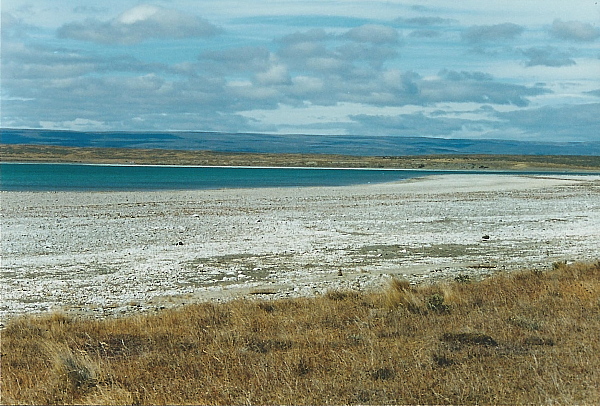
Monday 25 March. We birded along the road to Pali Alke National Park, highlights being 19 Darwin’s Rheas, Great Grebe, 2 Rufous-chested and 15 Tawny-throated Dotterel, 10 Least Seedsnipe, and 75 Grey-hooded Sierra Finches. We saw 4 Magellanic Penguins on the ferry across to Isla Grande and then drove down to Porvenir. Ruddy-headed Goose was our first new bird, seeing 2 then 13, as were 8 Short-billed Miners and 17 Magellanic Plovers, the latter was probably our main target for the trip and they did not disappoint. We also saw 30 Black-faced Ibis, 300 Chilean Flamingo, 500 Upland Geese (both white and barred morphs), 6 Flying Steamer Duck, Apolmado Falcon, 15 Two-banded Plovers, 12 Rufous-chested Dotterel, 7 White-rumped Sandpipers, Grey-breasted Seedsnipe, 50 Chilean Skuas, 8 Dolphin Gulls and 20 Patagonian Yellow Finches. A very enjoyable first day birding.
 |
| Magellanic Plover on Isla Grande |
 |
| always nice to see the main target species early in a trip |
 |
| Magellanic Plover with White-rumped Sandpiper |
 |
| Porvenir |
 |
| Porvenir Beach |
 |
| coast near Porvenir |
 |
| Dolphin Gull and Crested Duck at Porvenir |
 |
| Crested Duck |
 |
| Strait of Magellan |
Tuesday
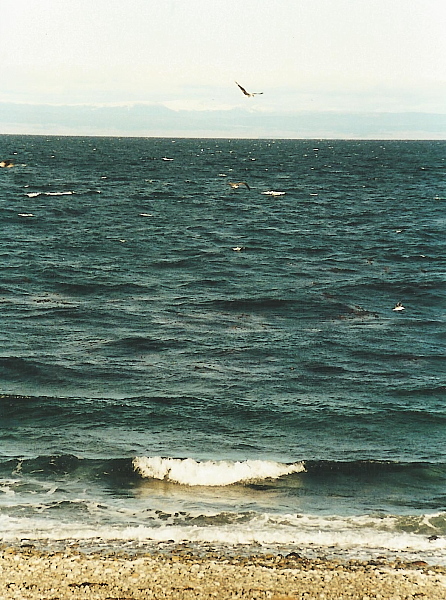
26 March. We woke to a strong westerly (onshore) wind and decided
to seawatch off Porvenir. The Strait of Magellan is about 25km wide
here, although it narrows to 5km at the northern entrance where we
crossed by ferry. Despite this we were surprised to see 150+
Black-browed and a Grey-headed Albatross, 4
Magellanic Diving Petrels, 3 Southern Fulmars, 2 Grey,
2 White-chinned and 2 Southern Giant Petrels, 30
Blue-eyed Shags and 200 Chilean Skuas. We saw 3 Kelp
Geese in Porvenir Bay and driving back north to the ferry 3
Magellanic Oystercatchers as well as similar, sometimes the same,
birds as previously - 10 Ruddy-headed and 400 Upland Geese,
8 Flying Steamer Duck, 6 Two-banded Plovers, 2
Rufous-chested Dotterel, 8 White-rumped Sandpipers, 10
Dolphin Gulls, 75 Short-billed Miners and 50 Patagonian
Yellow Finches. We also saw at least 31 Magellanic Plovers which were brilliant. We crossed back on
the ferry (seeing the same or another 4 Magellanic Penguins) and
spent the rest of the day on the Pali Alke Road and along the first
24km of the aptly named Punto Dungeness Road. We saw 12 Darwin’s
Rheas, White-tufted Grebe, female Cinereous Harrier
and an Austral Canastero as far as we went.
 |
| Isla Grande |
 |
| Magellanic Oystercatchers |
 |
| Laguna de Los Cisnes |
 |
| roadside Vicuna |
Wednesday
27 March. We birded back down the Pali Alke road, spent time
around a superb pool at km 3 and visited the Sen Otway penguin colony
before returning to Punta Arenas. Best birds today were 80 Darwin's
Rheas, 50 Magellanic Penguins (but sadly no wandering
Kings as were sometimes there), 500 Blue-eyed Shags (most roosting on the pier in
Punta Arenas), 75 Ashy-headed and 2500 Upland Geese, 3 Flying and a
Flightless Steamer Duck, 10 Two-banded Plovers, 8
Rufous-chested Dotterel, 19 adult and a juvenile Magellanic
Plover, 200
White-rumped Sandpipers, 89 Least Seedsnipe, 62
Dolphin Gulls, 2 Scale-throated Earthcreepers, 10
Short-billed Miners, a Dark-bellied
and 12 Bar-winged
Cinclodes, 3 Austral Canasteros, Dark-faced
Ground Tyrant, 4 Austral Thrushes and a superb male and 2
female Black-throated Finches (the day’s only new bird that
took a bit of finding first thing).
 |
| early morning on the Pali Alke Road, note frost on car windscreen, it was cold |
 |
| Pali Alke road |
 |
| Ashy-headed Geese |
 |
| Upland Geese |
 |
| Nick scoping on the km 3 pool |
 |
| we were watching Magellanic Plovers |
 |
| adult Magellanic Plover |
 |
| juvenile Magellanic Plover |
 |
| Darwin's Rhea from the track to Sen Otway |
 |
| Flightless Steamer Duck at Sen Otway doing a good impression of a grey rock |
 |
| Magellanic Penguins heading for the sea at Sen Otway |
 |
| Magellanic Penguins returning from the sea |
 |
| quite approachable |
Thursday
28 March. We flew from Punta Arenas to Puerto Montt where we
picked up our hire car and drove north then east to Puyuhue where we
saw eight new birds, being 3 Chilean Pigeons, 40 Austral
Parakeets (we couldn’t find any Slender-billed Parakeets but
weren’t sure they were present at this time of year), 5
Green-crowned Firecrowns, Striped Woodpecker, Des
Muir’s Wiretail, 4 excellent Black-throated Huet-Huets,
14 brilliant Chucao Tapaculos and a Common Duica Finch.
10 Thorn-tailed Rayaditos, a White-throated Treerunner
and 6 Patagonian Sierra Finches were also nice to see. We left
before dark for the long drive of about 600km north then west to
Nahuelbuta.
 |
| Punta Arenas Airport |
 |
| approaching the Strait of Magellan |
 |
| over the coast of southern Chile |
 |
| the southern Andes |
 |
| glacier in southern Andes March 2002 |
Friday
29 March. We almost became lost in Angol but a combination of
luck and instinct saw us on the right road, seeing a Barn Owl
before arriving at Nahuelbuta. Dawn didn’t seem long after we
arrived but we’d managed some sleep and had an excellent day
birding in the damp forest. A Chilean Tinamou ran across the
road and we saw White-throated Hawk, 45 California Quail,
40 Austral Parakeets (still no Slender-billed), 5 Green-backed
Firecrowns, female Striped and Magellanic Woodpeckers,
Chilean Flicker, a superb Des Muir’s
Wiretail, 30 Thorn-tailed Rayaditos, White-throated
Treerunner 3 Black-throated Huet-Huets, 5 Chucao and single Ochre-flanked and
Magellanic Tapaculos (all
excellent), 4 Patagonian Tyrants, Chilean Swallow,
6 Chilean Mockingbirds, 8 Common Duica Finches, 10
Austral Blackbirds and 15 Black-chinned Siskins. At
night we heard a distant Rufous-legged Owl which as often
seems to be the way had stopped calling by the time we got our act together and emerged from
our tents to look for it.

 |
| Monkey Puzzle or Araucaria at Nahuelbuta |
 |
| Southern Beech at Nahuelbuta |
 |
| a truly wonderful place |
Saturday
30 March. We spent much of the morning at Nahuelbuta seeing
similar birds to yesterday - 30 Austral Parakeets, 3
Green-backed Firecrowns, 2 Striped Woodpeckers, Chilean
Flicker, 20 Thorn-tailed Rayaditos,
Plain-mantled Tit-Spinetail, White-throated Treerunner
2 Black-throated Huet-Huets, again 5 Chucao and single Ochre-flanked and
Magellanic Tapaculos, 4 Fire-eyed Duicon,
Patagonian Tyrant, 3 Chilean Swallow,
4 Austral Thrushes, 6 Chilean
Mockingbirds, 12 Common Duica Finches,
3 Patagonian Sierra Finches and 2 Black-chinned Siskins.
Leaving we saw Chilean Tinamou by the road near Vegas Blancas where a
brief stop failed to produce Slender-billed Parakeet, adding weight
to our view that we were not looking at a good time of year. We drove
back to cross the main highway and continued east and up into the
Andes at Laguna del Laja. There before dark we saw Spot-flanked
Gallinule, 2 Green-tailed Firecrowns, 6 Dark-bellied
Cinclodes, 6 Thorn-tailed Rayaditos, 2 Dark-faced
Ground Tyrants and an excellent juvenile Chestnut-throated
Huet-Huet. The latter was the day’s only new bird and put us on
course to seeing all eight possible tapaculos. A nice thought for another cold
night.
 |
| Chuaco Tapaculo, a strong contender for my bird of the trip |
 |
| another Chucao Tapaculo at Nahuelbuta |
 |
| they were just so good |
 |
| Laguna del Laja entrance |
Sunday
31 March. We spent the morning birding at Laguna del Laja.
Just 18 species seen but they did include 2 more Chestnut-throated
Huet-Huets, 2 Torrent and 3 Spectacled Duck, 12
Green-backed Firecrowns, 8 Dark-bellied
and 5 Bar-winged
Cincloides, 6 Thorn-tailed Rayaditos,
3 Magellanic
Tapaculos and
25 Dark-faced
Ground Tyrants. We
packed up and continue north towards Santiago reaching Talca, about
half way, in daylight and seeing 12 Chimango Caracaras on
the way. We continued for several hours after dark to Puente Alto on
the southern outskirts of Santiago and southeast past San Jose del
Maipo. No new birds on what was really a travel day.
 |
| one of our warmer campsites, at the Laguna del Laja entrance with Volcan Antuco in the distance |
 |
| driving higher into the park |
 |
| the views became more spectacular the further into the park we went |


Monday
01 April. We slept
in a lay-by at the start of the dirt road up to Emblase El Yeso
having seen 4 Band-tailed
Nightjars on the way there. We
were up at dawn to discover
we had a puncture. The car
only had a small spare tyre, the first space saver I’d seen, and we
were nervous
driving on it but felt returning to the nearest town would end up
wasting all morning. The first of five Moustached Turcas
seen during the morning
was some compensation for having to change the wheel. We continued
somewhat anxiously
up to the reservoir but were not able to make sense of the directions
we’d been given to the site for Diademed Sandpiper Plovers. As we’d
seen them in Peru in 1984 I’d not given as much attention to
finding out about them
as I should have, assuming the site would be easy to find. We tried
three or four areas
off the track past the reservoir, which we
drove almost to the end of, without
success. Back home I
feel sure that we
had been
within 100m
of the site at the first place
we tried. Despite this we
had a decent morning seeing 15
Rufous-banded Miners, 4 Scale-throated Earthcreepers, 4 excellent
Crag Chilias, 4 Grey-flanked Cinclodes, 50 Greater Yellow Finches and
6 Yellow-rumped Siskins. We drove back to Puente Alto to fix our
tyre, the space-saver had done its job but had rather restricted
where we’d felt able to drive on the tracks at El Yeso. It took an hour or so, quicker than wed thought, and we continued through Santiago and
north to La
Campana.
 |
| road to El Yeso |
 |
| Emblase El Yeso |
 |
| above the reservoir was the area for Diademed Sandpiper Plovers |
 |
| looking back at the reservoir but we just couldn't find the precise spot |
Tuesday
02 April. We spent all day
birding along the tracks at La Campana seeing just 17
species but they did include good views of both our remaining
Tapaculo targets,
White-throated and
Dusky and we also
heard Moustached Turca.
The other
species seen
were 10 California
Quail, 15 Chilean
Pigeons,
a roosting Magellanic Horned Owl,
15 Green-backed Firecrowns,
Striped Woodpecker, 2
Dusky-tailed Canasteros,
6 Plain-mantled Tit-Spinetails,
White-throated Treerunner,
White-crested Eleania,
10 Tufted Tit-Tyrants,
4 Fire-eyed Duicons,
Chilean Swallow, 12
House Wrens, 5
Grey-hooded Sierra Finches
and 5 Rufous-collared Sparrows.
It was cold and after dark our candle kept blowing out until we thought
to cut the top off a cola bottle and use as a windshield, the
bottom being a handy mug. The joys of camping in poor weather.
 |
| dry forest at La Campana |

 |
| glad this one wasn't in my tent |
Wednesday
03 April. We had the morning at
La Campana recording a
similar selection of species to the previous day including 17
Chilean Pigeons,
Red-backed Hawk, 25
Green-backed Firecrowns,
2 Dusky-tailed Canasteros,
3
Plain-mantled Tit-Spinetails,
2 Thorn-tailed
Rayaditos, 8
Tufted Tit-Tyrants, 4
Fire-eyed Duicons and
2 White-throated
Tapaculos with
Dusky and Moustached
Turca heard. We
drove to Concon, on the
coast north of Valparaiso and
at the mouth of the Rio Aconcagua. Here we saw a range of wetland and
coastal species including 20 Peruvian Boobies,
100 Peruvian Pelcians,
White-necked Heron,
6 Chiloe Wigeon, 100
American Oystercatchers,
single Greater and
Lesser Yellowlegs and
Willet, 20 Hudsonian
Whimbrel, 100 Franklin’s
and 6 Grey Gulls, 350
Black Skimmers, 8
Inca Terns and 6
Austral Negritos. The
Franklin’s Gulls were mostly in superb summer plumage while I
almost dismissed the Hudsonian Whimbrel being rather casual on hearing their
familiar call and only raising my bins to count them forgetting they
were different from those at home. Our last stop was the rocky coast
at Quintero to the north. Here we found 7 Seaside
Cinclodes, the days new bird, 2
Blackish Oystercatchers,
Surfbird and 30
Turnstones. Offshore
were 2 Humbolt Penguins,
15 Sooty Shearwaters,
100 Peruvian Boobies,
250 Peruvian Pelicans
and 200 Neotropic
and 10 Guanay Cormorants.
We found a cheap place to
stay in Quintero.
Thursday
04 April. We started at
Quintero seeing 3
Humbolt Penguins, 50
Peruvian Boobies, 100
Peruvian Pelicans,
Blackish Oystercatcher,
2
Seaside Cinclodes and
3 Common Duica Finches.
We returned to the mouth of the Rio Aconcagua and the dunes to the
north where we spent the
rest of the day. Roosting
on an offshore island were at least 1000 Peruvian Boobies
and 250 Peruvian Pelcians
and we also saw Pied-billed
and 3 White-tufted Grebes,
7 Chiloe Wigeon, a female Lake Duck,
White-tailed Kite, 40
Red-gartered, 3
White-winged and 20
White-fronted Coot,
3 Collared
Plovers, 150 American
Oystercatchers, 10
White-backed Stilts,
Rufous-chested Dotterel,
Hudsonian Godwit,
Chilean Skua, 50
Franklin’s and 3
Grey Gulls,
350 Black
Skimmers, 2
Elegant and 6 Inca
Terns, 3 Burrowing
Owls, Green-backed
Firecrown, Wren-like
Rushbird, Plain-mantled
Tit-Spinetail, great
views of Dusky Tapaculo,
Many-coloured Rush Tyrant,
4 Tufted
Tit-Tyrants, 4 Fire-eyed
Duicons, 2
Great Shrike Tyrants,
20 Austral Negritos,
2 female Rufous-tailed Plantcutters,
100 Chilean Swallows
and 20 Yellow-winged Blackbirds.
The shrike tyrant and plantcutter being new. We
left the coast and headed up into the Andes to the ski resort of Portillo at an altitude of just under 2900m. Not surprisingly it was another cold night.
Friday
05 April. Our final day started in the Andes at Portillo. It was expectedly cold at dawn and
birds and us were very slow to become active. We slowly birded our way up to the 3800m Paso de la Cumbre before dropping down on multiple hairpins to the Argentinian border before returning. We saw 7 Andean Condors
(2 juveniles), 2 Red-tailed Hawks,
2 Mountain Caracaras,
a superb White-tailed Hillstar,
20 Rufous-banded Miners,
Scale-throated Earthcreeper,
7 Grey-flanked and 4
Bar-winged Cinclodes,
2 Plain-mantled Tit-Spinetails,
Cordilleran Canastero,
another excellent Moustached Turca,
Black-billed Shrike Tyrant,
Dark-faced and 2
Cinereous Ground Tyrants,
2 male and 2 female Rufous-tailed Plantcutters,
Austral Thrush, 10
Greater Yellow Finches,
25 Grey-hooded and 3
Ash-breasted Sierra Finches,
10 Rufous-collared Sparrows
and 20 Yellow-rumped Siskins.
I saw the White-tailed
Hillstar feeding on an isolated red flower but it shot off before
Nick arrived. It was a new bird for us having had a poor view of what
was almost certainly one at El Yeso a few days earlier. We searched
without finding any other flowers in the immediate vicinity and
thought it best to return to keep watch on the flower I’d seen it
on. We’d seen a TV programme, almost certainly one of David Attenborough's,
suggesting they had fixed circuits and revisited isolated flowers at regular intervals so hoped it
was just a question of time. After a long wait, which probably wasn’t
actually more than an hour, it returned and gave very good views before shooting off again.
Cinereous
Ground Tyrant was our other
new bird at Portillo and the last of the trip. We drove back down
towards
Santiago and
Estero Lampa. We pulled up
by the side of the road and were just leaving the car to look at some
duck
at the back of
a nearby pool
when a police car pulled up. Oh dear. Some
of our experiences of police in other South American countries had
not been encouraging but the officer walked up and offered a hand to
shake, the first time that has happened to
me. They wanted to know what
we were doing, that we were OK and hoped we enjoyed the rest of our
day, leaving us almost speechless. Commonest
ducks were 100 Yellow-billed
Pintail amongst
which we
added a Silver and 10
Cinammon Teal and 3
Red Shoveler to the
trip list as well as seeing
3 Chiloe Wigeon and 8
Speckled Teal. Two
White-faced Ibis and
a Plumbeous Rail were
also new for the trip and other
sightings included 2 White-tufted Grebe,
50 Red-gartered and
10 Red-fronted Coot,
34 White-backed Stilts,
Many-coloured Rush Tyrant,
5 Austral Negritos
and a Long-tailed Meadowlark.
 |
| early morning at Laguna del Inca at Portillo |
 |
| it was cold waiting for the sun to hit us |
 |
| looking down on Portillo |
 |
| near Paso de la Cumbre |
 |
| looking down on Argentina |
 |
| the far right peak is Aconcagua, 25km away in Argentina and at just under 7000m its the highest peak in the Americas |
 |
| me near the border |
 |
| heading back down |
 |
| impressive railway tunnel |
 |
| leaving the high Andes |
That
was it for the trip. We returned to Santiago and the next morning
flew to Buenos Aires and home. In a very enjoyable two weeks I’d seen 168 species of
which 36 were new, and all for about £1250. Best were the tapaculos,
especially Chuaco (the
following year a new field guide was published, fittingly it was on the front cover),
Magellanic Plover, Des
Muir’s Wiretail and Rufous-tailed Plantcutter. Thanks to Nick, as
usual, for being there and John and David Cooper for information and encouragement.
[Blogged
December 2019]