NE India part 2: Namdapha (14-18 January 2025)
This the second of three blog posts giving my take on an
Ornis Birding Expeditions trip to NE India. New birds for me are shown in red. Unless stated otherwise photos
are mine, mostly taken with a Sony RX10iv bridge camera.
Tuesday 14 January. We
left Tinsukia at 05:30, having earlier heard a Collared Scops Owl
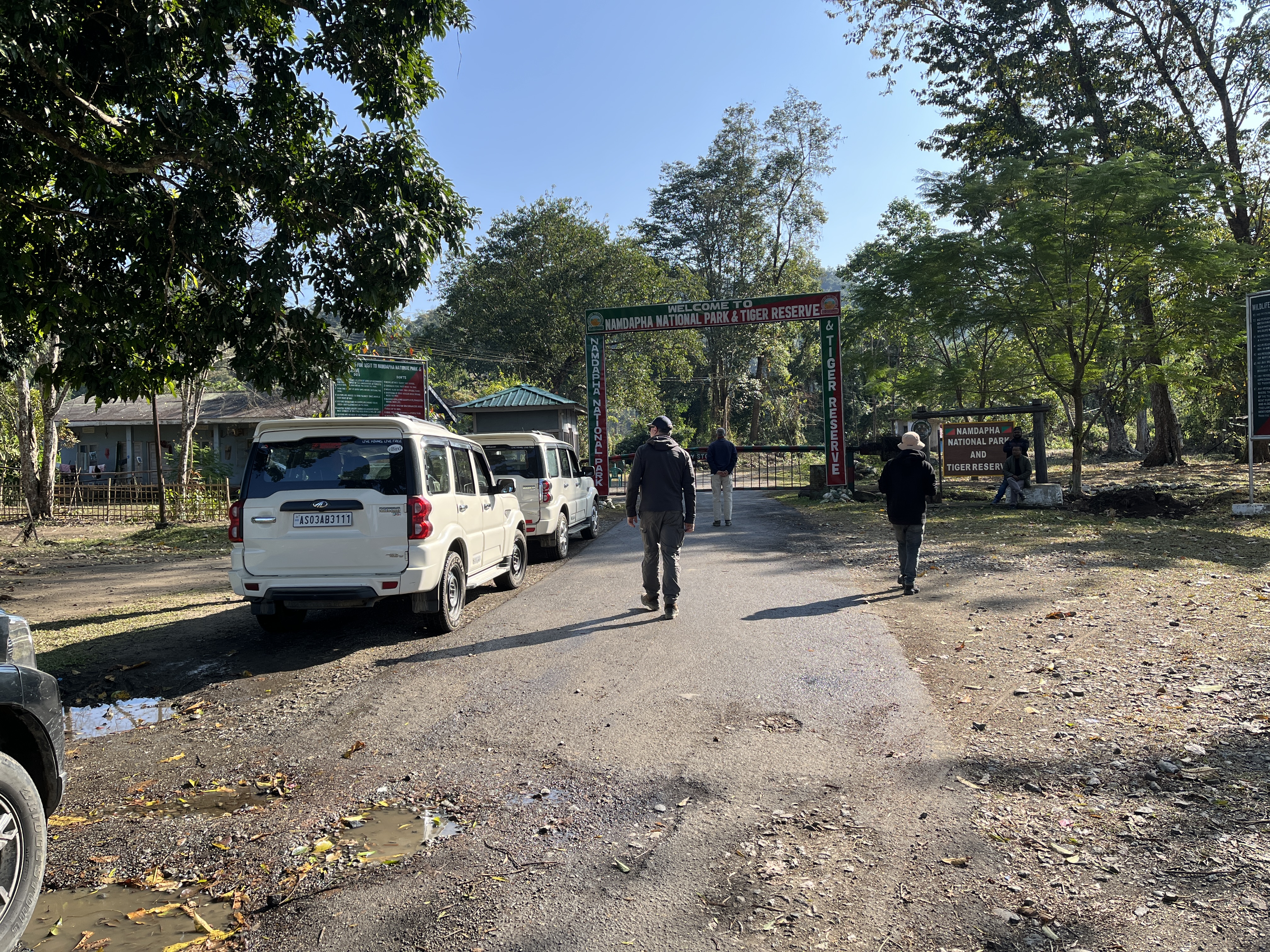
calling from a tree outside our hotel window. We drove to Namdapha arriving at
the entrance at Miao at 09:15. Paperwork was checked while we birded outside
although 8 Chestnut-tailed Starlings were the best I could come up with.
Once inside the park we almost immediately stopped by the Mpen Bridge for a
packed breakfast and then followed the river upstream for about a km looking primarily
for Blyth’s Kingfisher. We had no success despite spending a couple of hours in
the area. A Crested Kingfisher was some compensation as was renewing
acquaintance with Rufous-bellied Hawk Eagle, a rather smart Pale-chinned Flycatcher, 2 Little, 2 Black-backed, 3 Slaty-backed
and a White-crowned Forktail, Blue Whistling Thrush, 3 Plumbeous
Redstarts and 4 River Chats - happy memories of Himalayan river
avifauna. Hearing a Tawny Fish Owl in the forest above the river was
frustrating, particularly as it appeared to move closer at one stage. We had
been set to stay in a tented camp by a tributary of the Noa Dihing River 30 or
more miles into the National Park. It would have put us in a good location for
night birding but a recent edict from the National Park authorities prohibited visitors
from staying there and accommodation at Deban Ranger Station was the best we
could do. We continued to the ranger station at Mile 17 where we were given
decent rooms and lunch. At 14:00 we continued into the park on the road which loosely
followed the Noa Dihing River upstream towards the Burmese border, in places it
was little more than a muddy track. We made several stops, one involuntarily as
our vehicle was briefly stuck in the mud. Roadside birding was good with
several bird flocks encountered, although they quickly moved on. Best for me
were a pair of Rufous-necked Hornbills, 2 Pale-billed
Parrotbills, 20 Striated Yuhinas, Red-billed
Scimitar-Babbler, brief views of Snowy-throated
Babbler, 2 White-hooded Babblers and . Unfortunately a
strict nighttime curfew had recently been introduced in the National Park ruling
out all night birding and we headed back as it was getting dark. Other birds
I’d seen during the day included 5 Ashy-headed Green Pigeons, Mountain
Imperial Pigeon, Crested Honey Buzzard, 2 Mountain Hawk Eagles, Common and Pied Kingfishers, 2 Scarlet
Minivets, White-bellied Erpornis, 4 Bronzed and an Ashy
Drongo, 2 Yellow-bellied Fantails, Grey-headed Canary-Flycatcher,
Common Tailorbird, Grey-throated Babbler, Magpie Robin, 2 Siberian
Stonechats, Blue-winged Leafbird and Grey and White
Wagtails.
 |
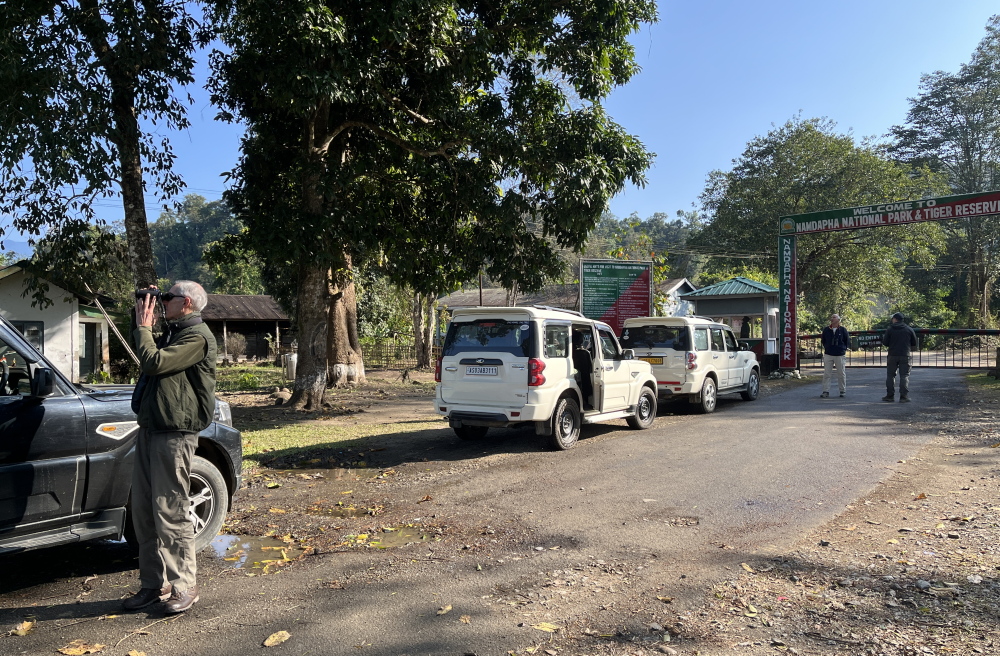
| Namdapha National Park, waiting to enter at Miao |
 |
| Pale-chinned Flycatcher by the Mpen Bridge |
 |
| Crested Kingfisher by the river |
 |
| Rufous-bellied Hawk Eagle over the Mpen Bridge |

 |
| bridge over the Noa Dihing River at Deban Ranger Station with a Pied Kingfisher just about visible on it |
Wednesday 15 January. We
left Deban Ranger Station at 05:00 with the first traces of dawn in the sky,
were soon let through the checkpoint and followed the road, a muddy track in
places, to the Hawa Mahal View Point where a brief stop confirmed that the
river was covered by low cloud. We continued and almost two hours out from
Deban we reached Mile 32 Watch Tower for breakfast. The tower gave a view of a sizable
section of the Noa Dihing River and a chance of seeing White-bellied Heron, or
it would have if the river valley hadn’t still been covered by a thick blanket
of cloud. We birded along the road beyond seeing 2 Oriental Hobbies, 2 Pale-billed
and 5 Rufous-headed Parrotbills, Black-chinned Yuhina, a Red-billed
and 2 Brown-crowned Scimitar-Babblers, 4 Snowy-throated and
2 White-hooded Babblers, Nepal Fulvetta, 3 Long-tailed Sibias,
9 Silver-eared Mesias and 2 Streaked Spiderhunters as the weather
improved. We continued to the bridge at Nysa Falls, another regular site for Blyth’s
Kingfisher but not then. Further on the road opened out somewhat and the Front
Base River opposite was clear enough to be scanned but we saw nothing. It was
probably where we had hoped to camp and looked ideal for Ibisbills but from
where we were it was probably too distant to see anything smaller than a heron
if that. We returned to the Mile 32 Watch Tower for lunch and spent three hours
scanning the braided Noa Dihing River seeing very distant, barely identifiable Black
Stork and Osprey. The previous Ornis trip had seen White-bellied
Heron from here, hence our efforts, but if the stork and osprey were anything
to go by views would have been hardly worth having. Wanting a change of scenery
Josh, Max and Mika opted to return to the first lookout (Hawa Mahal View Point)
to try for the heron. The rest of us drove back to Nysa Falls where after about
30 minutes Chris spotted a kingfisher sitting beneath the bridge. Blyth’s Kingfisher! Nice but a fairly brief view
as almost immediately a truck appeared, the first we’d seen all day, crossed
the bridge and the kingfisher flew before I could photograph it. We returned to
join the others at the Hawa Mahal View Point. They had had no luck with the
heron but a female Sapphire Flycatcher in the adjoining tree was most welcome. We returned
to Deban Ranger Station arriving at 17:15, the last part in the dark. Other birds
seen included 5 Mountain Imperial Pigeons, male Red-headed Trogon,
Wreathed Hornbill, Crested Kingfisher, Scarlet Minivet, Bronzed
Drongo, 4 Yellow-bellied Fantails, 3 White-throated Bulbuls,
2 Slaty-backed and a Spotted Forktail, 8 Blue Whistling Thrushes,
2 Plumbeous Redstarts and 3 River Chats.
 |
| early morning view from Mile 32 Watch Tower |
 |
| Oriental Hobby at Namdapha |
 |
Front Base River, Namdapha
|
 |
| Front Base River, Namdapha |
 |
| White-bellied Heron habitat from Mile 32 Watch Tower |
 |
| Rufous-headed Parrotbill (photo: Josh Bergmark) |
Thursday 16 January. We
left Deban Ranger Station soon after 05:00 and drove fairly steadily, with a
brief stop for some Kalij Pheasants on the road (I was in the last
vehicle and saw 2 males), to the Burma Nala Bridge just before a small village
and another checkpoint. We had been told that most days a White-bellied Heron
flew down the small tributary, under the bridge to the Noa Dihing River and off
but at 07:45 might it already have done so? We settled in amongst the roads
where the stream joined the river, had breakfast and watched to 10:15 but no
heron appeared although forktails kept us entertained. One of the rangers had
scrambled up the stream for a km or more above the bridge but the heron wasn’t
feeding up there. Somewhat despondent we returned to the Mile 32 Watch Tower
and spent until 16:00 scanning from there but saw very little. Our return to
Deban at 18:00, well after dark, was noted and by all accounts a black
mark/yellow card issued. Indian bureaucracy which is probably the fault of us
Brits. A disappointing day and with just one day left at Namdapha serious
consideration was given to the following day’s plan with various options
mooted. My feeling was that at the river by the bridge if the heron flew by it
would be hard to miss and give good views while although it might be more
likely to fly past Mile 32 it would be easy to miss there if it flew past behind
the trees below us and very hard to see/identify if it flew past on the opposite
side. We seemed to settle on a morning at the bridge with options after. Birds
seen during the day included Mountain Imperial Pigeon, 2 Wreathed
Hornbills, Blue-bearded Bee-eater, male Grey-chinned Minivet,
3 Bronzed Drongos, Collared Treepie, 3 Yellow-bellied
Fantails, 2 White-throated Bulbuls, Hill Prinia, 3 White-naped
Yuhinas, 10 Silver-eared Mesias, 4 Fairy Bluebirds, female Rufous-bellied
Niltava, 2 Slaty-backed and a Spotted Forktail, 2 Blue
Whistling Thrushes, 3 Plumbeous Redstarts, 2 River Chats,
female Hodgson’s Redstart, 3 Brown Dippers and 2 White
Wagtails.
 |
| Slaty-backed Forktail near the Burma Nala Bridge |
 |
| Front Base River, Namdapha |
 |
| Collared Treepie at Namdapha (photo: Josh Bergmark) |
Friday 17 January. We
left at 05:00 and drove straight to the Burma Nala Bridge, arriving at 07:30
just as the early morning mist was lifting from the Noa Dihing River. Full more
of hope than expectation we settled in beside the river and breakfasted while
scanning. Might our slightly earlier arrival, before the mist had fully
cleared, make a difference? It soon became apparent that it hadn’t. Either the
heron left roost before it was physically possible for us to arrive (given
curfew to 5am) or it sometimes/often roosted elsewhere. Not that it made a
difference either way, we were not seeing it. We scanned for the heron until
10:00 and were on the riverbank preparing to leave when the ranger helping us
started shouting ‘heron’. And there it was, a White-bellied
Heron, flying up stream towards us! It briefly landed opposite
before continuing around a bend 400m away. A brief celebration followed - a combination
of elation and relief (at not having to go back to the Mile 32 viewpoint!) - before
we hurried up the stoney riverbank to the bend and cautiously looked around the
corner. The heron was standing in the middle of the river 150m away. We slowly
approached but it flew another 200m or so before disappearing further upstream.
We returned to the cars and headed back, stopping for lunch at Nysa Falls but the
Blyth’s Kingfisher wasn’t about. We were back at Deban Ranger Station at 13:30
and crossed the river opposite (called the Noa Hadang here according to Google
Maps) on a flimsy bamboo bridge (the one photographed on our first day). Leaving
the river we soon joined a trail through enclosed forest with patches of large bamboo.
We were hoping for Rufous-vented Laughingthrush but not today although a male Green Cochoa and Pale-headed Woodpecker were
more than adequate compensation for me. We returned at 17:00 as the light was
going, a final scan of the riverbanks failing again to produce an Ibisbill. Back
at the ranger Station an Asian Barred Owlet called briefly. Other birds I saw
included Mountain Imperial Pigeon, Indian Pond Heron, male Red-headed
Trogon, 2 Wreathed Hornbills, 2 Common Kingfishers, Maroon
Oriole, Yellow-bellied Fantail, 2 Little, 3 Slaty-backed
and a White-crowned Forktail, Blue Whistling Thrush, Rufous-gorgeted
Flycatcher, 4 Plumbeous Redstarts, Blue Rock Thrush, male Black-throated
Sunbird and 2 White Wagtails.
 |
| Little Forktail at Burma Nala |
 |
| Noa Dihing River at Burma Nala |
 |
| White-bellied Heron at Burma Nala having realised we were on the opposite river bank |


 |
White-bellied Heron (photo: Josh Bergmark)
|
 |
| White-bellied Heron in the Noa Dihing River |
 |
top heron spotter who saved our day
|
 |
| opposite Deban Ranger Station |
 |
| Green Cochoa near Deban |
 |
| Green Cochoa at Deban (photo: Josh Bergmark) |
Saturday 18 January. We left Deban at
05:30 and drove towards the park entrance waling a few sections of the road
hoping for a last change Rufous-vented Laughtingthrush. No luck, we’d had mixed
fortunes with laughingthrushes and this species was particularly uncooperative.
A flock of at least 16 Austen’s Brown Hornbills was impressive and we
saw 40 Pin-tailed Green Pigeons, Mountain Hawk Eagle and another Oriental
Hobby but it was rather quiet. Just before reaching the park entrance we stopped
by the Mpen Bridge and after a quick breakfast walked up river again with
another birding group hot on our heels. We soon saw a Blyth’s Kingfisher
but it kept some distance ahead of us, the other group pushing it more than we
did. Also along/by the river were a secretive Slaty-bellied Tesia, 2 Black-backed
and a Slaty-backed Forktail, 2 Plumbeous Redstarts and a River
Chat. Around the park entrance, while we were being checked out, were 2 Peregrines,
15 Grey-throated Parakeets, a Great Myna and a White-cheeked
Starling amongst a small flock of Chestnut-tailed. We left the park
and drove to Roing, the gateway to the Mishmi Hills. We dropped out bags at the
rather grandly named but fairly basic Siwundi Winds Yatri Niwas Resort before spending
the rest of the afternoon birding in the Jia Grasslands to the south. I found it
a rather frustrating habitat with the grass often taller than I was and the
birds there very reluctant to shown themselves. I did see 2 Smoky Warblers,
Pin-striped, Rufous fronted and eventually decent views of Marsh Babbler, 2 Spot-winged Starlings (amongst
small flocks of Chestnut-tailed) and 5 Olive-backed Pipits. Other
birds seen during the day, many from the drive, included 20 Little Cormorants,
White-throated Kingfisher, Maroon Oriole, Greater Racket-tailed,
2 Hair-crested and an Ashy Drongo, a Long-tailed and 2 Grey-backed
Shrikes, Rufous and Grey Treepies, Black-crested Bulbul,
Asian Fairy Bluebirds and Orange-bellied Leafbird.