Saturday, 12 April 1997

VIETNAM 1997: Cuc Phuong and Cat Tien (29 March-12 April)

I went to Vietnam at Easter 1997 with Nick Preston, Tom Francis, Doug Page, Alan Whealdon and Norman Williams. Nick and I had been keen to go for several years and it was now possible to do so. Tom and Doug were thinking along the same lines and we decided to team up, four being the ideal number. However Alan and Norman got wind of our trip and the first I knew of their interest was after they had booked flights. Vietnam was opening up to tourists and a visa from their London embassy was needed. I applied for mine in good time but it wasn’t clear that I needed to include a return envelope. This became apparent when I chased mine up a couple of weeks after it was due. After some searching the person in the Visa Department found my passport with issued visa under some papers. It would probably still be there now if I’d not phoned. This blog is based on unreliable memories, scant notebook entries and illustrated with a few digitised prints of views.

Saturday 29 March. After an overnight flight we arrived in Bangkok seeing 3 Little Cormorants, Javan Pond Heron, Asian Open-billed Stork and 4 Black Drongos from the terminal. We then flew to Hanoi where a vehicle was waiting to take us to Cuc Phuong National Park. We arrived at dusk having seen White-throated Kingfisher, Ashy Wood Swallow and more Black Drongos on the way. Accommodation at the Bong Substation, about 20km into the park, was basic but perfectly adequate and one of the locals brought us meals from HQ by motorbike. Tony Palliser was also staying at Bong, having arrived before we did.
Bangkok Airport
Hanoi
motor scooter looked to be the commonest form of transport

Sunday 30 March. After looking around the Bong clearing Nick and I decided to spend most of the day on the loop trail, first birding the grids then climbing up on the ridge. It was very cloudy and a bit damp. We started really well seeing a male Fukien Niltava and the first of three vocal male Bar-bellied Pittas encountered during the day. Bar-bellied was my most wanted bird and it is always nice to see the main target early on. We continued birding along the trail and bumped into Tony. The three of us continued along the trail which eventually started dropping and continued to do so for some time. By now we were a little concerned that we might have taken a wrong turning, or missed the right one, but we were on a well-used trail, not that anyone else was on it, and had seen no alternatives. Time was getting on but we felt we’d past the point of no return so continued as it must lead somewhere. We continued dropping, left primary forest and descended into more open scrub, then we could see paddyfields and a small village - we’d managed to walk out of the park. We arrived in the village just before dusk and, with some difficulty, managed to make our predicament understood and negotiated for three guys with motorbikes to take us back to Bong. It wasn’t far off a 50km trip as we had to travel the length of the park to enter at the HQ and then once inside back to the Bong substation. I’d only once been on the back of a motorbike in the 25 years since since leaving School and was probably like a dead-weight for my poor driver. Back in the park about 5kms short of Bong I was probably too rigid going around a corner and we skidded over in the rain. I’d had enough and walked the rest although the others eventually sent the van back for me. By then I was almost home, and very wet despite an umbrella. I had also managed to melt the sole of one shoe unknowingly resting it on the motorbike’s exhaust pipe although I didn’t realise that until later. An eventful first day that rapidly went downhill, in many respects, since our early success with Bar-bellied Pittas. Other notable birds seen were the disappearing back of a male Silver Pheasant, 2 Long-tailed Broadbills, 2 Puff-throated Babblers, 2 Streaked Wren-Babblers, Rufous-throated Fulvetta and a male Hanian Blue Flycatcher. It rained all night.
outside Cuc Phuong
Monday 31 March. It rained for most of the day. Nick and I concentrated on the Bong clearing, grid trails and the road. We’d be out early, return mid-morning for a late breakfast and be out again until dusk. The highlight was a male Pied Falconet seen from the clearing. We also saw 18 low-flying White-vented Needletails, 3 Red-vented Barbets, 2 Grey-capped Pygmy Woodpeckers, 3 Lesser Yellownapes, a Greater Goldenback, 2 Mountain Fulvettas, a male Mugimaki Flycatcher, female Maroon Oriole, 3 White-winged Magpies and 2 Ratchet-tailed Treepies. A Bar-bellied Pitta was heard but didn’t show.
Bong clearing on a damp, murky morning
Tuesday 01 April. It was dull but at least it didn’t rain all day. We’d established a routine of being out early, returning mid-morning for a late breakfast and then be out again until dusk. Nick and I concentrated on the grid trails hoping for Blue-rumped Pitta but with no success although another male Bar-bellied Pitta was reasonable compensation. We also birded along the road. Birds seen included the male Pied Falconet, 25 Chinese Bulbuls, 3 Rufous-throated Fulvettas, 2 Hanian Blue Flycatchers, an immature male Crested Bunting and a White-winged Magpie. Silver-breasted Broadbill had been seen by the others, a new bird for Nick who wasn’t best pleased and didn’t mind who knew. I was starting to worry about Blue-rumped Pitta which no one had seen or heard but we had another day and a half at Cuc Phuong.
Cuc Phuong
Wednesday 02 April. Nick and I concentrated on the Bong clearing and ridge part of the loop trail. We saw some nice birds, the best day so far, with another male Bar-bellied Pitta, 9 Thick-billed Green Pigeons, male Red-headed Trogon, a Red-vented and 3 Green-eared Barbets, a superb male and 2 female Silver-breasted Broadbills, 11 Olive-backed Pipits, Great Iora, 2 Fairy Bluebirds, Chestnut-backed Shrike, female Purple Cochoa, Orange-headed Ground Thrush, 2 Eye-browed Wren-Babblers, a Hwamei, 3 Rufous-throated Fulvettas, Manchurian Bush Warbler, Eastern Crowned, Dusky and 4 Arctic Warblers, Fukien and White-tailed Niltavas, 2 Hainan Blue Flycatchers, the same Crested and a Chestnut Bunting, 9 Hill Mynas, 3 male Maroon Orioles, 3 White-winged Magpies and 2 Ratchet-tailed Treepies. I should have been pleased with some decent sightings but I went back to the ridge later and by the big tree heard what I was sure was Blue-rumped Pitta call just once. I froze and scanned around but I wasn’t sure which in direction it had come from and it didn’t call again. Very frustrating and it was my turn to have a strop and miss the meal. I was asleep when Nick came back which was to prove unfortunate.
the big tree at Cuc Phuong
Thursday 03 April. I went out half an hour or so before dawn to get up to the big tree early in the hope the Blue-rumped Pitta, if that was what I’d heard, would be more obliging. I didn’t wake Nick assuming the plan to leave to drive to the coast after breakfast held good. My early start paid off with a Malay Night Heron flushed from beside the trail near the big tree. I also saw 4 Red-headed Trogons and a Bay Woodpecker and heard Bar-bellied Pitta. Previously breakfast had been between 10-11 and although I was happy to skip it I didn’t want to be late and reluctantly dragged myself away. Once back on the road I decided to have a final walk through the grid trails parallel to it. While on the grid I heard a vehicle door slam and what was presumably our minibus drive off. I legged it to the road but too late, it had gone. I was back at Bong at 10:30 to find the caretaker with a note from Nick. They had apparently waited three hours for me and left. Just as well I’d not fallen down a gully on the ridge trail and broken a leg. Pity I wasn’t aware that breakfast was going to be at least three hours earlier than usual. The note said they would arrange transport to Tam Dao for me at the HQ and send the van back the next day if they couldn’t. The caretaker told me Nick had been attacked by a tame peafowl while tying his shoe laces and had a nasty head wound so they were going to the HQ and would wait for me there. This didn’t seem likely as if so why not send the van back for me when they’d seen to Nick but I was too uptight about being left to think clearly. What I should have done was shrug my shoulders and go back to looking for Blue-rumped Pitta. I should have stayed at Bong another night but I was running short of food and we’d not ordered any for that evening. There might not be any transport from Bong the following day either. On the off-chance they were waiting at HQ I stuffed my sleeping bag in my otherwise already packed rucksack and started walking as quickly as I could. It took a little over three hours, the last part being quite painful as some grit had found its way into my shoes and not done the soles of my feet much good. At HQ it came as no surprise that the others had left. I was given a room in the guest house and birded around the HQ for the rest of the day but my heart wasn’t really in it and a White-rumped Shama was the best I managed. Before dark a couple of Westerners arrived with a jeep. They were staying at Bong but then heading back to Hanoi the following morning and kindly offered me a lift back with them if I still needed it.
Friday 04 April. I birded around the HQ but walking was still painful and I soon sat outside the HQ waiting for my lift. I later found out that Nick had phoned the HQ while I was waiting outside and was told that I had left. I eventually did, arriving at Hanoi mid-afternoon. I negotiated for the jeep to take me on to Tam Dao where I arrived after dark and found a guest house. At 930m it was appreciably cooler than Cuc Phuong which was nice. It had effectively been a feeling pissed off cum travel day so I didn’t see much. My highlights were 12 Grey-faced Buzzards, 2 Crested Serpent Eagles, male Bar-winged Flycatcher-Shrike, 2 Yellow-browed Warblers and a male Black-naped Monarch. The others went out by boat to some mudflats where they successfully saw Spoon-billed Sandpiper, Saunder’s Gull and Chinese Egret although I wasn’t sure why they needed to leave so early the previous morning to do so s it was only three hours away. All would have been nice although I would have preferred Blue-rumped Pitta.
leaving Cuc Phuong


driving back to Hanoi
Saturday 05 April. The day started off dull and thick mist rolled in mid-morning making birding difficult. My lacerated feet didn’t help either. I bought what I thought were two hard boiled eggs from a stall and was surprised to find they were raw – I’d been so used to eggs in the Himalayas being sold hard boiled. My feeble attempts with a Vietnamese Phrasebook were no help at all. Nick had a small scar on his head from his Bong peacock attack but fortunately the bleeding soon stopped, the rest I did my best to ignore (no change in habits there then). I saw White-browed Piculet, 4 Golden and a Spot-necked Babbler, 3 Black-throated Laughingthrushes, 5 Silver-eared Mesias, 6 Grey-cheeked Fulvettas, 7 Black-chinned Yuhinas, 3 Yellow-browed, 2 Arctic and an Eastern Crowned Warbler and 2 Green Magpies.
typical weather at Tam Dao
Sunday 06 April. Thick mist all day made birding almost impossible and I only saw 17 birds of 8 species and one of those, Eastern Crowned Warbler, was only a probable. Streak-breasted Scimitar Babbler, 4 Golden Babblers, 3 Silver-eared Mesias, 3 Grey-cheeked Fulvettas, 1 Black-chinned Yuhinas, Slaty-bellied Tesia and 3 Oriental White-eyes. The Slaty-bellied Tesia was about 0.5m above the ground on a branch that was sloping at a gradient of about 1:3. It was singing as it jumped along the branch one step up or down and was absolutely brilliant. A definite mood improver.

Monday 07 April. Our last morning at Tam Dao. Visibility was good and my feet were on the mend but birds remained thin on the ground. Nick and I concentrated on the steps up to the transmitter which turned out to be a good move as we saw 5 Grey Laughtingthrushes and even better 5 superb Short-tailed Parrotbills, both of which were new. Crested Honey Buzzard and Golden-throated Barbet were the only other species new for the trip and my Tam Dao total moved up to 28. We returned to Hanoi and caught a flight to Ho Chi Min City. We’d arranged a vehicle to take us to Cat Tien National Park, about 160 km to the North. The journey seemed to take ages and we were very pleased to cross the river and be shown three chalets near the park headquarters. It was hot and humid, although not unexpectedly so.
a clear day
Tam Dao
Hanoi Airport
leaving Hanoi


over the Mekong River


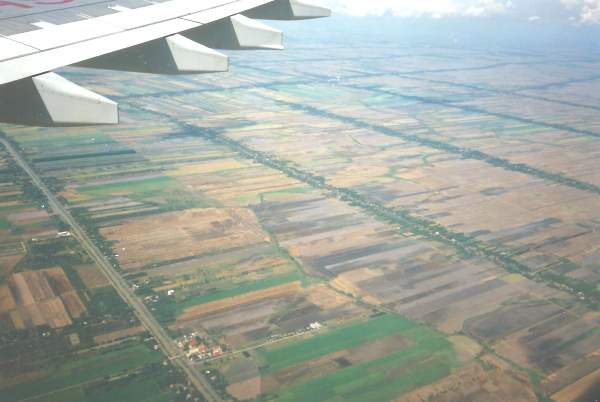
approaching Ho Chi Min City
Tuesday 08 April. All day on forest trails at Cat Tien, mostly with Nick. One of the trip’s highlights was a male Bar-bellied Pitta watched feeding then preening for 20 minutes. Also seen were male Red Junglefowl, 2 Emerald Doves, 2 each of Great Eared and Large-tailed Nightjars, 10 Brown Needletails, a pair of Orange-breasted Trogons, Great Hornbill, Red-vented Barbet, Heart-spotted Woodpecker (a real heart-stopper), Black & Red Broadbill, 3 White-rumped Shamas, male Chestnut-bellied Rock Thrush, 7 White-crested Laughingthrushes (in three groups), Radde’s Warbler and 7 Vinous-breasted Starlings.
big tree at Cat Tien
Wednesday 09 April. We left early and were taken for an hour or so by jeep to Dac Lua, an area of the National Park near where there was a slim chance of Orange-cheeked Partridge. We didn’t even hear one but not being there at dawn probably didn’t help. We birded the dirt road on the way back and forest trails around the HQ. We heard Germain’s Peacock-Pheasant and amongst others saw a pair of Red Junglefowl dust-bathing, 2 Black Bazas, 5 Green-billed Malkohas, 10 Brown Needletails, Stork-billed Kingfisher, 2 Blue-bearded Bee-eaters, Green-eared, 2 Blue-eared and a Coppersmith Barbet, White-bellied, Laced and Black & Buff Woodpeckers, 28 Red-breasted Parakeets, Black & Red Broadbill, 3 Blue-winged and 4 Golden-fronted Leafbirds, 4 White-rumped Shamas, 3 Velvet-fronted Nuthatches, Asian Golden Weaver, 2 Golden-crested Mynas, 4 Black-hooded Orioles, 2 Racket-tailed Treepies and a mouse deer. Before going for an evening meal Nick and I had to quickly evacuate our chalet due to cloud-like insect infestation. We left a couple of windows open and fortunately most had gone (for good) when we returned as we didn't fancy sharing with them despite having brought our own mosquito nets..
open area at Cat Tien
the main track in Cat Tien


Thursday 10 April. Much of the day was spent on the forest trails, mostly on my own. They day’s highlights for me were a Germain’s Peacock-Pheasant preening on a log for five minutes and another on the road nearby for a couple of minutes. A third was later seen on rock where it was calling in full view for several minutes before slowly walking off. Superb, as was a male Bar-bellied Pitta watched on a log for two minutes. I also saw 4 Red Junglefowl including a male on the road, Black Bittern, Lesser Adjutant, 2 Emerald Doves, Banded Bay and male Violet Cuckoos, a day-roosting Barred Owlet, Brown Hawk Owl, 4 Great Eared Nightjars, 15 Brown Needletails, female Banded and Stork-billed Kingfishers, 3 Blue-bearded Bee-eaters, Great Hornbill, 5 Black & Buff and 4 Great Slaty Woodpeckers, flight views of a vocal Blue-winged Pitta (heard towards dusk in an area we’d been to most days so we assumed it was new in), good views of a female Siberian Blue Robin, 3 Grey-faced Tit-Babblers, 2 White-crested and 6 Black-throated Laughingthrushes, Two-barred Greenish and Pale-legged Leaf Warbler, a Brown and 2 Taiga Flycatchers, male Tickell’s Blue Flycatcher and 7 Racket-tailed Treepies. Back at HQ we saw Jon Eames had arrived at Cat Tien and we spent some time catching up with him in the evening as we’d all known from autumn visits to Scilly in the early 1980s. Blue-rumped Pitta was often hard to find and would probably have to wait for a return visit one day.
butterflies on the edge of the main track
Friday 11 April. Our morning at Cat Tien, birding along the main track with Jon Eames. Two Blue-winged Pittas were calling and we had good views of one and flight views of the other. Even better for me were the two broadbills I’d failed to find on previous trips to South-East Asia. Thanks to Jon’s amazing hearing (and knowledge of calls) we tracked down parties of both seeing 5 Dusky and 4 Banded Broadbills. Other birds encountered were 2 Black Bazas, female Red Junglefowl, heard only Germain’s Peacock-Pheasant, 4 Brown Needletails, male Banded Kingfisher, 2 Blue-bearded Bee-eaters, 2 Wreathed and an Indian Pied Hornbill, 3 Great Slaty Woodpeckers, 2 Grey-faced Tit-Babblers, 6 White-crested Laughingthrushes, 6 Brown and a Taiga Flycatcher and a male Crimson Sunbird. We left Cat Tien National Park early afternoon, crossing the river and piling onto the van that was waiting for us. We drove to Ho Chi Min City where we checked into a reasonable hotel quite near the airport.

Saturday 12 April. I saw a Tree Sparrow in Ho Chi Min City and nothing at Bangkok Airport. Our return home was uneventful, as it should be. not my most enjoyable trip but it had some great moments, Bar-bellied Pitta particularly was as good as I'd hoped.
leaving Vietnam


Postscript. Nick and I returned to Vietnam in 2009 where I saw Blue-rumped Pitta twice at Cat Tien, on our first full day after Nick had gone back for lunch (!!), and again with Nick when it hopped out onto the trail soon after dawn on our last morning. It was well worth going back for. I’ve since seen the three birds I missed by not going to the coast so I’m no longer bitter about being left behind at Cuc Phuong (well not so much)! I saw Saunders’s Gull in Japan in 2003 and China in 2010, Chinese Egret in Philippines in 2008, China in 2010 and Taiwan in 2011 and Spoon-billed Sandpiper in China in 2010. Nice as they were, well maybe not the egret, for me Blue-rumped Pitta wins hands down.

[blogged April 2020]

Friday, 30 August 1996

NEW ZEALAND 1996: Stewart Island to Auckland (20-30 August)

20 August 1996:  We left the car at Bluff and caught the local supply boat, the Marine Maid, which sailed for Stewart Island that morning.  This was a rather slow vessel which enabled reasonable views of seabirds to be obtained, or would have had there been many on the crossing.  As it was, it extended a period of boredom from one hour to over two!  Halfmoon Bay on Stewart Island was very reminiscent of Hugh Town on St. Mary’s and we soon settled in Anne’s Place, a cheap backpacker’s just out of town.  This was to prove to be an excellent base for the next couple of days.  The weather had worsened, with the wind picking up and squally showers and we were concerned as to whether Philip Smith's evening kiwi trip to Ocean Beach would go ahead.  It was the most eagerly anticipated part of our trip and a conversation with Philip was not as reassuring as we would have liked!  A visit to Acker’s Point (just under an hours walk from Anne’s Place) produced good views of Weka but the rough seas made our hearts sink.  Fortunately the wind eased during the rest of the afternoon and the rain held off to enable the trip to go ahead.  Nick, four others and I left in Philip Smith’s boat just before dark.  The trip started well with Philip telling us he’d only failed to see kiwi once in 6 years of taking visitors and that he’d seen 11 kiwi’s on his previous visit a week before, although this was tempered by also being told that the weather had been much better then and that kiwis were much harder to see in bad weather like this eveninng’s!  Not really what we wanted to hear although 35 Little Blue and 1 Yellow-eyed Penguin from the boat took our minds of kiwis for a while.  We landed at The Neck and after waiting 15 minutes for it to get dark set off across a narrow isthmus to Ocean Beach.  Being shown kiwi tracks, kiwi ‘runs’, kiwi droppings and places where Kiwi’s beaks had probed the sand did little to ease the tension as we walked further and further down the beach without seeing an actual kiwi.  Philip then told us he ‘would have expected to see a kiwi by now and had seen several by this time on his last trip’, sinking further our hopes.  With the end of the beach fast approaching and me thinking it’s going to be 2 dips in 6 years at this rate, Philip spotted a kiwi blundering around behind some marram grass.  What an amazing bird.  It then gave excellent views for 10 minutes when we had to leave it although another was seen on the walk back down the beach.  The whole experience, amazing as it was, was over far too quickly and I could happily have stayed all night but unfortunately the amount of time Philip is allowed to spend with the kiwis is limited for their protection – not that they seemed to be the least bit bothered by us.  A memorable day, 32 species recorded including 3 new ones and the bird of the trip.  I'd seen a kiwi!
Halfmoon Bay, Stewart Island
Halfmoon Bay
me at Acker's Point, somewhat anxious as the rough see might prevent the much anticipated kiwi trip from going

21 August 1996:  A wet day with quite strong winds, so just as well we had made it to Ocean Beach the previous evening.  We persuaded a boatman to take us to Ulva Island, possibly against his better judgement, and boarding his boat was quite entertaining.  It took no time to get there and being landed on the sheltered side of the island presented no problem.  We arranged to be picked up 4 hours later and slowly wandered around this idyllic island.  The more notable birds were 6 Wekas, 6 Kakas, both Red and Yellow-crowned Parakeets and 35 New Zealand Brown Creepers.  We returned to Anne’s place to dry out and did little during the remainder of the day.  We would happily have returned to Ocean Beach if another trip had been going that evening.  Not that there were any other takers, but Philip wasn’t licensed to visit on consecutive days.  We heard on the radio of heavy snowfalls in the mountains and that several of the passes (including the Lindis Pass) were closed.  Although we had time to return to the western side of South Island, we’d seen all we could hope to at this time of year and the possibility of getting stuck made it a less attractive proposition.  28 species recorded, the 6 Kakas being the highlight.

Halfmoon Bay at low tide
Ulva Island
Weka on the shoreline


Ulva Island
22 August 1996:  As the Foveaux Strait crossing was so poor we booked a return on the mid-day sailing of the fast (1 hour) Southern Express catamaran.  We walked to Acker’s Point again that morning before collecting our bags.  There appeared to be many more birds in the Foveaux Strait but viewing was not easy from the fast moving catamaran.  We would have been better off on the slower boat although we did identify 8 Buller’s Albatrosses.  Once back in Bluff we quickly drove to Nugget Point, very much a race against the setting sun, arriving with half an hour of light left and just in time to see 1 Yellow-eyed Penguin waddle up the beach.  Leaving Nugget Point we came across a French couple who had skidded their camper van into a ditch.  We gave them a lift into Kaka Point, the nearest town, and got them assistance at the Fish & Chip Shop.  In conversation, one told us he was a medical student doing national service on New Caledonia.  Had he seen Kagu I asked optimistically and was completely gripped to be told he’d seen them walking round a picnic area in the Rivière Bleue Reserve.  Nick and I wished then that we’d fitted a few days on New Caledonia into our itinerary, although knowing Kagu could be relatively easy to see made us determined to do so soon.  We drove on to Dunedin and the Otago Peninsular sleeping in the car near Cape Saunders.  38 species seen but little of interest other than those mentioned above, the Yellow-eyed Penguin being the highlight of the day.


final walk to Acker's Point, rare patch of blue sky!
23 August 1996:   Up at dawn, we drove down a muddy track towards the coast south of Cape Saunders and seawatched for a couple of hours seeing a few albatrosses.  Returning up the muddy road was more difficult but we managed it, just, and then continued on to the Royal Albatross colony at Taiaroa Head.  This is fenced off and access only allowed on an organised ‘tour’.  This included a tour of the information centre and a compulsory 25 minute video with only 15 minutes in the hide.  We did not really fancy this and having had amazing views off Kaikoura from the Virgo we decided to watch from outside, seeing 13.  Here we also witnessing a big passage of over 500 Spotted Shags moving south in less than an hour.  Leaving Otago we drove north to Katiki Point, stopping to look at the nearby Moeraki Boulders first.  We had been sitting in the hide at Katiki for over an hour, somewhat disappointed to see only 2 rather distant Yellow-eyed Penguins, when the lady in charge invited us into the fenced off area.  Here we had excellent views of 17 individuals on the beach and walking up to their nest sites.  A fine spectacle.  We left as the light was going and continued north to Oamaru where, after obtaining directions from a garage, were too late for the nightly Little Blue Penguin spectacle, seeing just one by the side of the road.  We decided to revisit Lake Benmore, and drove inland west towards Omarama before finding a suitable picnic area to put up the tent.  38 species seen including some excellent seabirds, the highlight being the 17 Yellow-eyed Penguins.
Otago Peninsular
Spotted Shags
Taioroa Head


me at the Moeraki Boulders

Katiki Point
Yellow-eyed Penguin
24 August 1996:  Up at dawn we drove on to Omarama and then north to Lake Benmore, stopping almost immediately as a seemingly pure Black Stilt flew over the road.  At Lake Benmore we tried to drive to the braided river by taking a track to the north of the power stations but without a four-wheel drive it was impossible and despite walking some distance we never managed to approach the area we were hoping to reach.  We eventually returned to the area which we had visited a week earlier.  There were generally fewer birds to be seen and at a greater distance than we had remembered.  Rather disappointedly we continued on to Lake Tekapo where a brief look at the southern end of the lake was unproductive.  With the light fading we drove northeast towards Christchurch, camping in a lay-by just south of Ashburton.  33 species seen, the highlights being 10 Double-banded Plovers and 3 Black Stilts.


Lake Benmore


25 August 1996: After a slightly disturbed night, being right next to the main north-south road, we packed up the tent and drove northeast to Kaituna Lagoons at the extreme eastern end of Lake Ellesmere.  A Great White Egret was the only bird of note and we soon continued on to the Banks Peninsular.  This was very spectacular with a steep climb before dropping down to Akaroa Harbour.  Being a Sunday it seemed to be full of day-trippers and was very busy.  We drove as far round the eastern side of the harbour as we could and then continued walking for a mile or so towards the southern end of French Bay, eventually being halted by a private keep out sign.  On the walk back we had rather distant views of 5 White-flippered Penguins out in the harbour and on returning to the car decided to try and drive to the coast at the end of Lighthouse Road in the hope of a seawatch.  We drove out of Akaroa but the road was incredibly steep and when it changed to dirt we decided it probably wasn’t sensible to continue.  Returning we continued north to Kaikoura and arrived with an hour or so of light left, having had a brief stop in Christchurch (a very clean city and pleasantly quiet on a Sunday).  The M.V. Virgo’s winch was being repaired, dashing our hopes of another seabird trip the following day and we decided to try the Whalewatch boat instead, returning to our ‘usual’ car-park to sleep in the car.  35 species seen, the highlight being a flock of 75 Black-fronted Terns roosting at Kaikoura.
Banks Peninsular

Kaikoura at sunset
26 August 1996: We arrived at the Whalewatch Office in Kaikoura as it opened and booked places on the morning trip.  When feeding at this time of year Humpback Whales are solitary and seem to spend 2-3 minutes on the surface and then dive for up to 20 minutes, often travelling some distance underwater.  Because of this the Whalewatch boat, a fast catamaran called the Wawahia, is guided onto a whale by two zodiac teams with sonar equipment.  With only a couple of minutes to reach the whale before it dives it is necessary for all passengers to remain strapped into their seats and this makes birding very difficult.  We saw 2 Humpback Whales but the views and the whole commercialised experience was a big disappointment, and not a patch on our previous encounters with Whales (Southern Rights in Argentina and South Africa).  Birds were a disappointment too, with many fewer seen than from the M.V. Virgo, although to give them their due the Whalewatch crowd did circle some Royal Albatrosses on the return.  In the afternoon we drove inland a short way to Mount Fyfee Forest but few birds were seen, a flock of 4 Brown Creepers in the scrub above the car park being the most notable.  Seawatching produced little and at dusk we drove to Lake Elterwater where we put up the tent in a rather noisy lay-by.  33 species seen with 4 Royal Albatrosses from the Whalewatch boat being the highlight.
Whalewatch boat
Humpback Whale, going
going, gone ...
Kaikoura
Kaikoura headland

Kaikoura from Mount Fyfee Forest

27 August 1996: Up at dawn we were soon checking a large flock of Chaffinches and Yellowhammers hoping for a Cirl Bunting, but to no avail..  Wildfowl on the lake included 14 Australian Shoveller and 15 New Zealand Scaup.  We drove on to Picton hoping to cross to Wellington a day early but as we’d made an advance booking we would have lost the associated discount.  As the extra cost was almost as much as a day return for a foot passenger, we chose to do this and had two crossings on the Aratika.  These were particularly excellent when passing close to, or crossing the wake of, a fishing boat, some of which were trailing long ‘tails’ of albatrosses.  A total of 126 albatrosses were seen on the crossings including 14 Royals and 1 Buller’s.  When we returned to Picton it was late afternoon and after the usual fish and chips we drove a few kms along Queen Charlotte Drive, in low cloud, before finding a suitable place to camp.  40 species seen with Royal Albatrosses again the highlight.
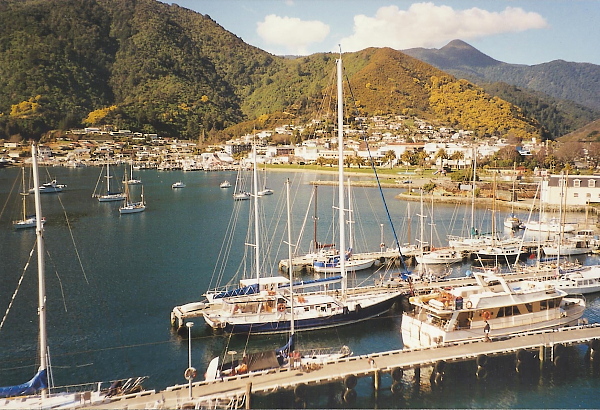
Picton
Queen Charlotte Sound
The Interislander
Wellington
28 August 1996:  We boarded the Aratika again for the morning sailing to Wellington, this time with the car, but very many fewer birds were in evidence and only a few distant trawlers were seen.  Once in Wellington we started driving north, stopping briefly opposite Kapiti Island where 500 Hutton’s Shearwaters were moving in the freshening wind.  We continued driving north, seeing little and in deteriorating weather.  We reached Waiouru late afternoon and took the Iron Road to Turangi.  Any hopes of seeing Mount Ruapehu in the fading light were dashed as we were engulfed in a blizzard, although the volcano’s presence was obvious from the very strong sulphur smell.  We continued driving, after a food stop, and arriving at Miranda very late, we slept in the car.  Just 22 species were seen, the highlight being 18 Shy Albatrosses from the Aratika.


Kapiti Island
29 August 1996:  Early morning at Miranda watching waders, including their first Eastern Curlews of the season.  Only 3 Wrybills and no Double-banded Plover were found, most having moved south to the breeding grounds (we must have passed the Wrybills on our way north).  After a brief stop at Island Block Road, where the river was in flood, and an abortive look for Spotless Crake near the Upper Mangatawhii Reservoir (not having a tape didn’t help) we returned to Auckland in the late afternoon, somewhat exhausted .  49 species were recorded with 7 New Zealand Dotterel at Miranda being the highlight.

30 August 1996: I caught an early morning flight to Sydney on 30th while Nick returned, with Ruth and Emma, her young daughter, on a more civilised flight at mid-day.  I had a 7 hour wait in Sydney and arrived in England just an hour ahead of them.  I saw 9 species from Sydney Airport, where it rained heavily most of the time.  Black-winged Kite and Magpie Lark were the highlights.


Nick and I covered much of New Zealand and thought it a brilliant country.  So much so that, ignoring birds, it is the only place I have visited where I’d probably prefer to live than England.  August, being mid-winter, was not an ideal time to visit but he only time we could get away for more than two weeks.  A few seabirds are more regular at this time of year but others move out of New Zealand waters.  Some of the endemic species are harder to find in winter and we failed to see Rock Wren, not that we expected to.  The sites we had for them were under snow.  Attempts to look for Great Spotted Kiwi near Punakaiki were also thwarted by the access road being flooded, although apart from this we were generally lucky with the weather, in particular by leaving the west coast of South Island ahead of blizzards which closed some of the roads we had used a few days earlier.


Due to the time of year (less daylight, likelihood of poor weather, birds not so vocal etc.) we allowed longer in New Zealand than one would have done in summer.  This was to maximise the chance of seeing most of the endemic species and we planned a north-south itinerary that allowed time to look for birds on our return north that we might have missed travelling south.  In the event, and with the possible exception of White-flippered Penguin, we saw no new birds after leaving Stewart Island.  An alternative we had considered while planning the trip was to fit in a short visit to New Caledonia (for Kagu) but the cost of flights from Auckland exceeded £400 return which was rather off-putting.  In hindsight this would have been a better option and meeting the French doctor who had seen them at Rivière Bleue made us very regretful of not having done so.  Something for the hit list for fairly soon.

Many thanks to Ruth and family for looking after us so well, Nick for being an excellent travelling companion and Gary for an unforgettable trip on the MV Virgo.


[blogged July 2015]