Monday, 19 August 1996

NEW ZEALAND 1996: South Island (13-19 August)

13 August 1996:  We were up at dawn and drove into Wellington to catch the 08:00 ferry to Picton.  The crossing, on the Arahura, produced our first Cape Petrels, Fairy Prions and a Royal Albatross with Common Diving Petrels and Hutton’s Shearwaters very common in Queen Charlotte Sound.  A brief stop at Lake Elterwater produced nothing of note and we soon continued on to Kaikoura where the rest of the day was spent.  The terns around the Fur Seal colony were good and a few seabirds were seen rather distantly.  That evening Nick contacted the skipper of the M.V. Virgo who was happy for us to join him when he checked his nets the following morning, provided it wasn’t too rough.  With a feeling of anticipation, and some anxiety given the rising wind, we slept in the car by the Fur Seal colony.  33 species were recorded, the 100 Cape Petrels being the highlight of the day.

inter-island ferry crossing Cook Strait, snowy mountains of South Island in the distance
Queen Charlotte Sound
the road south to Kaikoura was spectacular
it would be an impressive train journey too
looking northwest from the headland at Kaikoura

14 August 1996:  We met Gary and his crewman on the quay before dawn and were soon off, squeezed into the deckhouse.  It was cold and there was a heavy swell, while reports on the radio suggested worse weather further south.  Gary did not appear to be at all concerned, exhibiting a calmness I did not feel!  After a couple of hours of bouncing around seeing very little we arrived at his first net.  Up until this point in my life seabirds had been rather mythical birds one glimpsed from headlands if lucky and couldn’t really identify without a bit of imagination while pelagic trips involved hours of boredom and a few Bonxies.  The next 3 hours challenged this conception completely, not that my identification of seabirds has improved very much and I still prefer to be on dry land!  As the nets were drawn in and fish gutted, a mass of birds surrounded the boat and descended on the innards as they were thrown overboard.  We estimated at least 2000 Cape Petrels, 20 Royal, 3 Wandering, 30 Shy, 2 Buller’s and 15 Black-browed Albatrosses, 20 Grey Petrels and 15 Westland Black Petrels were round the boat, some almost close enough to touch (and readily photographed with a standard lens).  It was a magical experience and we were sorry when the final net had been reset and we turned for home, although the return journey was just as memorable with a small pod of dolphins riding the bow wave inches from where we were sitting for 20 minutes.  Two hours seawatching from above the Fur Seal colony was a distinct anticlimax after the Virgo.  We departed Kaikoura towards Arthur’s Pass, getting as far as Waipara before dark.  We drove on to Arthur’s Pass camping by the Hawden Shelter.  A very memorable day despite only 29 species being recorded.  Wandering Albatross was the bird of the day.

seabirds from the MV Virgo off Kaikoura.  Probably Wandering, Black-browed and Royal Albatrosses, Southern Giant and Cape Petrels and Kelp Gulls 
gulls, Cape Petrels and albatrosses
Wandering and Black-browed Albatrosses with Cape Petrela
Black-browed and Wandering Albatrosses and Cape Petrels
Black-browed, Shy and Royal Albatrosses with Cape Petrels
Black-browed, Shy, Royal and Wandering Albatrosses with Cape Petrels (this is the above image digitised from the negative rather than a print, interesting how different the colours are)
Wandering and Royal Albatrosses with Southern Giant and Cape Petrels
Black-browed and Wandering Albatrosses and Cape Petrels
Dusky Dolphins riding the bow-wave
returning to Kaikoura, seabirds would never be the same again
MV Virgo back in Kaikoura.  Thanks guys.
Fur Seal
15 August 1996:  A couple of hours wandering up the Hawden Valley at first light produced very little so after packing up the tent we drove up to Arthur’s Pass.  By this time it had started to snow and a brief look at a river were Blue Duck had been seen the previous November was soon abandoned.  We saw 4 Keas but little else and decided to go on to Punakaiki.  As we descended the snow became rain and the weather started to brighten up a bit.  We went first to Bullock Creek to see where to look for Great Spotted Kiwis that evening but after 2-3 kms the road into the site was seriously flooded and we could go no further.  A walk back along the road looking for Weka was looking to be unsuccessful, although it did produce our first New Zealand Brown Creeper, until we returned to the car to find a Weka crouched under it!  This bird and another then gave amazing views.  After a brief look at the pancake rocks at Punakaiki, where Westland Black Petrels were obvious gathering offshore, we waited by the road south of Punakaiki River to witness the petrels returning to their burrows.  We saw at least 1000, though observations were interrupted on occasion when we retreated into the car to avoid particularly heavy showers.  Birds still seemed to be coming in after dark, but with the rain becoming more persistent we decided to call it a day.  Trying for the kiwis was impractical given the rain and flooded road so we drove south, sleeping in the car just south of Ross.  Only 27 species were recorded, possibly due to poor weather, but 3 were new.  Weka was clearly the highlight.

Hawden Valley campsite at dawn.  it was cold!


Arthur's Pass

Weka at Punakaiki

impressive sized feet
Punakaiki
me at the pancake rocks


16 August 1996:  We were up at dawn and drove down the Westland Coast with stops at the southern end of Okarito Lagoon, Franz Josef and Fox Glaciers and Lake Paringa.  All were pleasant, without producing many birds.  The last two hours of the day were spent at Munroe’s Beach seeing three Fiordland Crested Penguins which appeared in the breakers and quickly walked up the beach into the rocks at the foot of the cliffs - superb.  Despite it being mid-winter sandflies were a problem at Munroe’s Beach, particularly as we’d not thought to take any repellent with us.  We continued past the town of Haast and started to climb towards Haast Pass, stopping in a layby near Okuru Forest to sleep in the car.  36 species recorded of which only one was new and few of the others were particularly significant.

Westland

Frans Joseph Glacier

Fox Glacier


Munroe's Beach
17 August 1996:  After a cold night we quickly drove up to Haast Pass and spent a very enjoyable two hours on the bridle track walking on an amazing carpet of moss through absolutely stunning woodland.  Best birds were an amazing 27 Riflemen and 6 Yellowheads as well as 2 Kakas, 3 Yellow-crowned Parakeets, 10 Tomtits and 2 New Zealand Brown Creepers.  We then drove fairly steadily to Wanaka (for supplies) and over the spectacular Lindis Pass to Twizel.  Taking a road east just before Twizel led us past the Power Stations and on to the northwest end of Lake Benmore adjacent to the braided river complex.  We watched until dark seeing 5 Black Stilts, 1 Pied Stilt and 1 hybrid as well as 20 Double-banded Plovers.  Birds were generally rather distant but two Black Stilts did give close views enabling us to be confident of their purity.  We were expecting Black Stilts to be much harder to pick out but were pleased this was not the case.  Perhaps this is a good time of year to find them, with most Pied Stilts and hybrids not having returned from their northern migration?  34 species were recorded of which 3 were new.  This was one of the best days of the trip, the 27 Riflemen the inevitable highlight.  After much debate we decided not to stay at Lake Benmore that night and drove on south towards Te Anau, putting up the tent in a layby near The Key at 2 am.

Westland
Haast Pass

Lake Wanaka

Lake Hawea

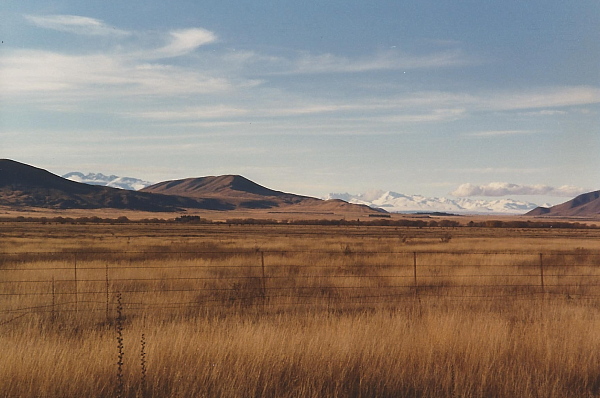
Lindis Pass

Lake Benmore

dusk at Lake Benmore
18 August 1996:  A cold night and up at dawn, we drove through Te Anau and out towards Milford Sound, stopping at the Mirror Lakes (rather unimpressive) and Homer Tunnel (rather scary).  Few birds were seen although Keas gave good views, especially at the Homer Tunnel were one landed on the car as soon as we stopped and needed to be discouraged from shredding the window seals.  Homer Tunnel was covered in snow (up to a foot in places) and any idea of seeing Rock Wren hopping round the boulders nearby were immediately dashed.  There are very few winter sightings with suggestions they feed around boulders below the snow perhaps no more fanciful than them hibernating.  A great pity as they look a stunning bird.  We continued down to Milford Sound where a Great White Egret was present and after deciding not to go on a very touristy and rather expensive boat trip on the sound we returned through the Homer Tunnel to Lake Gunn.  Here we had a pleasant walk through excellent woodland before putting up the tent.  Few birds were evident at Lake Gunn, possibly due to the cold, although 3 Riflemen were seen.  Just 21 species recorded, the lowest daily total of the trip and also the first day with no new birds, though Rifleman was again a worthy highlight.

Eglington Valley

Mirror Lakes


upper Eglington Valley
Kea in a parking area, waiting for unwary motorists!

road to Homer Tunnel
near Homer Tunnel

colour-ringed Kea "K" at the Homer Tunnel with its eye on our windscreen wipers and window seals.  It had to be chased away repeatedly and on one occasion it under-estimated the slipperiness of the bonnet and skidded in a rather undignified manner off onto the snow!


Milford Sound


19 August 1996:  We returned to Milford Sound for a final look around but soon left after stops at Homer Tunnel (nothing), Lake Gunn (7 Riflemen) and Knobb’s Flat (4 Riflemen).  The woodland was superb but appeared to have very low bird densities.  We left this area and bought some supplies in Te Anau before driving to Invercargill.  I was lucky enough to see a New Zealand Falcon as it shot across in front of the car between The Key and Mossburn.  Unfortunately it could not be relocated and as the light soon faded we continued on our way.  After a visit to another excellent Fish & Chip Shop in Invercargill we ended up sleeping in the car at Bluff.  While enquiring in the local pub about boats to Stewart Island Nick was told if we’d been a couple of days earlier we could have got a lift on a week trip in someone’s brother’s boat to a couple of the Sub-antarctic Islands.  Even I, not liking boats, would have jumped at the chance.  It was noticeably warmer but rather breezy.  25 species were recorded including, sadly, what turned out to be the last Riflemen of the trip.
Milford Sound


near Homer Tunnel


Eglington Valley
moss covered forest in the Eglington Valley


Monday, 12 August 1996

NEW ZEALAND 1996: North Island (7-12 August)

Introduction.  This blog recounts a visit to New Zealand with Nick Preston in August 1996.  It is based on a report I wrote soon after with some additional and perhaps unreliable memories and is illustrated with digitised prints taken with a basic Pentax camera and low magnification zoom lens. Many of the birds seen were very confiding although that is not reflected in the few bird photos I managed to take.  

Nick arrived in New Zealand the day before me, having been in Queensland, Australia for the previous two weeks.  We used my sister Ruth and brother-in-law’s house, conveniently located in Titirangi, Auckland as a base and borrowed one of their cars for a nominal charge.  We covered much of New Zealand and thought it a brilliant country.  So much so that, ignoring birds, it is the only place I have visited where I’d probably prefer to live than in England.

Away from Auckland we usually camped or slept in the car.  Exceptions were on Tiritiri Matangi Island where basic accommodation was provided and Stewart Island where we stayed in an equally basic Backpacker’s.  Both were very moderately priced.  It was necessary to take supplies to Tiritiri Matangi Island, which Ruth had kindly ought for us, but elsewhere snack-type food was readily bought.  Most evenings a local fish and chip shop was visited and, almost without exception, these were excellent.

August, being mid-winter, is not an ideal time to visit.  With less daylight, likelihood of poor weather and birds not so vocal we allowed longer in New Zealand than perhaps one would have done in summer.  A few seabirds are more regular at this time of year but others move out of New Zealand waters.  Some of the endemic species are harder to find in winter and we failed to see Rock Wren, not helped by the sites we had for them being under snow.  Attempts to look for Great Spotted Kiwi near Punakaiki were also thwarted by the access road being flooded, although apart from this we were generally lucky with the weather, in particular by leaving the west coast of South Island ahead of blizzards which closed some of the roads we had used a few days earlier.

7 August 1996:  After 28 hours of flying (via Sydney) I arrived in Auckland early in the afternoon and was met at the airport by Nick who had borrowed my sister Ruth’s car.  We spent a couple of hours at nearby Mangere Treatment Works before going to my Ruth’s house in Titirangi.  The tide was rising while we were at Mangere and our visit culminated with a flock of 80 Wrybills roosting on a small island in one of the pools which gave good views from the road.  33 species were recorded, the other highlights being our first Paradise Shelduck, Australian Shoveller, South Island Pied Oystercatchers and Red-billed Gulls and 30 rather distant Royal Spoonbills.

leaving Sydney

8 August 1996:  After a quick breakfast, accompanied by the ubiquitous Grey Fantail, we packed the supplies bought for us by Ruth and drove to Gulf Harbour Marina, Whangaparaoa to get the excursion boat to Tiritiri Matangi Island.  Most of the 20 or so visitors were going across for a day trip but Ruth had booked us in for two nights.  The journey on a fast boat took approx. 30 minutes but the speed of the boat made birding difficult and only an Australian Gannet and a probable White-fronted Tern were seen.  Tiritiri is a truly magical place and we were overwhelmed with birdsong on our arrival.  We were met just above the jetty by 3 Takahes and had seen several Saddlebacks, Tuis and Bellbirds on the short walk to the accommodation.  This was very adequate ‘bird observatory’ standard with a communal kitchen.  We spent all day walking round the island which is about 2.5 kms long and 1 km wide with replanted natural forest in valleys on the southwestern side, an insight into what native New Zealand was like.  At dusk Little Blue Penguins appeared offshore (having seen 3 in burrows earlier) and after dark 3 Grey-faced Petrels were seen around their nesting area.  Sixteen Little Spotted Kiwis had been released on Tiri during the previous three years and we were very keen to see one.  After a simple meal we walked around until nearly 01:00 by which time we were both finding it very hard to stay awake – at one stage I laid down on a section of boardwalk and could have easily fallen asleep. We heard four, one of which was very close, although frustratingly not close enough for us to see it.  We recorded 40 species of which 15 were new for me.  Takahes were the most impressive (a total of 7 being seen and other highlights were New Zealand Dotterel, Red-crowned Parakeet, Whitehead, New Zealand Robin and Stitchbird.

Tiritiri Matangi
Tiri was full of birds (and birdsong) with Takahes taking on the 'meet and greet' role
they were real heavyweights
Tiri quay


boardwalk through native woodland in the main valley on Tiri.  We heard Little Spotted Kiwis here but were unable to find them

9 August 1996:  Another enjoyable day on Tiri.  Again 40 species were recorded and again Little Spotted Kiwi was only heard, although by evening it was raining and we only heard one twice in nearly 2 hours.  New Zealand birding presents significant problems for the purist.  The inability of many native species to cope with predators (in particular possums) introduced by early European settlers has devastated many of their populations.  To ensure their survival the Department of Conservation reintroduces native species onto small, predator-fee, offshore islands.  Visitors are allowed on a few of them (Tiri being the most accessible) and as these are often the only places these species can be seen we had no qualms about counting them.  We had hoped to visit Kapiti Island which is also home to similar introductions to those on Tiri, although some have been established for longer.  This was not possible as no access to the island was allowed at the time of our visit as it was being blitzed with rat poison.  Fluttering Shearwater and Morepork were new birds for me, the later some compensation for drawing a blank again with Little Spotted Kiwi.  Other highlights included 45 Little Blue Penguins (brilliant), 38 Saddlebacks, 11 Stitchbirds, 13 Whiteheads and 3 Takahes.


the northern end of the island was more like moorland and so less interesting

10 August 1996:  After a quick last look around Tiri we paid our bill in the shop, being joined while doing so by a Takahe!  We returned to Gulf Marina on a boat which had been chartered to bring a walking club over.  The fast crossing produced poor views of 100 Fluttering Shearwaters.  We drove back to Titirangi stopping off at Pollen Island (in south Waitemata Harbour, west Auckland) where we saw a Fernbird with little trouble, other than plodging through mangroves to reach the site, and heard at least one other.  We had another very pleasant night in Titirangi preparing for the main part of the trip.  I recorded 35 species, the highlights being the Tiri specialities and Fernbird.
distant view of Auckland as we headed to Pollen Island
11 August 1996:  We left Auckland soon after dawn and drove for an hour or so south to Island Block Road just off route 1 near Meremere.  The extreme western part of the road was a site for Australian Bittern and walking along the southwestern bank of the river where it is crossed by the road we saw 3 with ease.  We then drove on to Miranda and saw a reasonable selection of waders, the best being 7 Double-banded Plovers, 4 New Zealand Dotterel and 140 Wrybills.  Other more notable birds included 3 Royal Spoonbills, a Cattle Egret, 2 introduced Eastern Rosellas and our first good look at White-fronted Terns.  With the tide falling we decided to cut short our visit at Miranda and drive to Rotorua in the hope of seeing New Zealand Little Grebe before dark, and thus save half a day on the itinerary.  The drive was fairly uninteresting and took 2-3 hours but we arrived with an hour of light left.  The point north of the Polynesian pools complex gave excellent views of 6 New Zealand Little Grebes, 1500 New Zealand Scaup and our first Black-billed Gulls (which we may have overlooked previously).  After an excellent fish and chips we drove to Pureora Forest Park.  We initially had difficulty finding Plains Road, our best Kokako site, but did so eventually.  It was clearly too cold to sleep in the car and we put the tent up in record time.  47 species were recorded, the New Zealand Dotterel being best.


12 August 1996:  We awoke at dawn and almost immediately heard a Kokako calling nearby.  We hurried into the forest and were soon rewarded with reasonable views of it coming in to investigate our tape recording.  The rest of the morning was spent walking along Plains Road and at the Observation tower.  Notable birds included 3 excellent Riflemen, 8 Tomtits, 4 Kakas (though in silhouete only) and 2 non-introduced Whiteheads.  We then drove to the Manganuiateao River northwest of Raetihi.  Stopping to scan from the road along a 5 km stretch of river beyond Orautoha we found 3 pairs of Blue Duck which were excellent.  This was after a false start when, at the first view of the river, I spotted two distant birds tucked up asleep under a river bank which looked ‘good’.  They turned out to be Mallard but our disappointment was short lived when a pair of Blue Duck suddenly appeared on the rocks below us - presumably having drifted downstream while we were intent on studying the Mallard!  We left this area late afternoon and on the drive back to Raetihi I saw a California Quail running across the road while Nick dozed in the passenger seat.  Just before dark we drove past the still smoking Mount Ruapehu, unfortunately with the top covered in cloud, and continued south towards Wellington, spending the night in the car near Plimmerton.  31 species were recorded with Rifleman and Blue Duck vying for ‘bird of the day’.

Pureora
views from the observation tower


Manganuiateao River 
prime Blue Duck habitat

Mount Ruapehu