Monday, 2 February 2015

ECUADOR 2015: Rio Bigal (30 January-2 February)

This blog continues my account of a trip to Ecuador with Marc Brew, Jon Hornbuckle and Rod Martins and very professionally led by Gabriel (Gabo) Bucheli. Unless stated the photos in this blog were taken (mostly by me) with Jon's Canon Powershot SX50.

30 January (continued).  We met Thierry Garcia, a very likeable ex-pat Frenchman, at the only obvious hotel in Loreto at around noon and had a packed lunch in their lobby, our wellingtons which we’d not had chance to clean leaving a trail of dried mud.  We got the things out of Gabo’s vehicle for Rio Bigal having repacked the previous evening so as not to have to take at least half of our stuff - I’d put a bag of the things I might need in Rod’s rucksack.  A large pickup taxi was summoned and we all piled in with our stuff in the back.  Thierry and Cesar, his cook, were dropped at the local market to buy final provisions while the taxi driver took us to his house to pick up a large gas cylinder.  We collected Thierry and Cesar who joined the bags of supplies and Gabo in the back giving Jon a cardboard tray of eggs to nurse.  We headed east out of town and after a few kms turned north onto a dirt road which we followed for twenty minutes or so.  Two mules and their muleteer were waiting to take our gear and supplies the final 5-6 km to Rio Bigal and while they were being loaded we started walking.  The track immediately became very muddy, treacherously so in places, and it was clear why we could not have driven any further.  Most of the walk, which took about two hours, was through cleared areas with scattered trees that did not seem particularly productive although we saw Green-backed Trogon, Many-banded Aracari and Violaceous Jay.  We did not enter decent forest until shortly before the turn off to the lodge, having been passed by the mules a few minutes earlier.  The turn-off was not at all obvious, a narrow almost invisible trail despite the fact that two mules had just gone down it.  So much so that Jon, who was some way ahead at this stage, walked right past it, Gabo catching up with him 0.5 km further on.  The trail was dark, muddy and steep in places but after five minutes we came to the lodge set in a small clearing.  It was very basic open ended affair with a downstairs living area, upstairs sleeping area where Thiery set up tents, mattresses and sleeping bags and adjacent shower and toilets.  The setting was brilliant, just my sort of place to be right on site.  After sorting out our stuff we headed back to the entrance track and continued further down it for the final hour or so of daylight seeing Blackish and Western Wood Pewees and Lafresnaye’s Piculet.  We had an excellent meal and an early night.
Thierry and his guys prepare loads for the mules.  The planks were not coming but supposedly to improve the track. Hmm.
Jon looks on
a short way down the trail was this viewpoint.  It was the only river we saw.

Gabo scanning the distant canopy, unfortunately in vain
Morpho or Owl-eye 
Smooth-billed Ani
Roadside Hawk
on the way to Rio Bigal, our eggs were being well looked after by Cesar

male Green-backed Trogon

going home
31 January.  After an early breakfast we spent the morning dodging showers as we birded along some of the narrow trails at Rio Bigal.  They included the intriguing Hot Lips trail, named for a plant.  Our main target was Pink-throated Brilliant but they were not playing ball and a probable flypast for some was the best we managed.  A male Ecuadorian Piedtail was good consolation for me and I also saw Sooty and Spot-backed Antbirds, Amazonian Umbrellabird and Striped Manakin.  We returned for lunch and in the afternoon tried our luck further along the entrance track, first calling in at a shelter where we disturbed a roosting Blackish Nightjar.  Pink-throated Brilliant had been seen on some flowers a km or so along the entrance track but few hummers were in evidence.   One that was was a male Gould's Jewelfront - the same genus as the brilliant and even better looking.  We had spread out a bit when Gabo got a good view of a perched Pink-throated Brilliant but it immediately flew (I heard it go) and with no flowers in the immediate vicinity did not return. Disappointing but it would have been more so had I missed the jewelfront.  The track was more open than the trails and we saw Paradise, Golden and Masked Tanagers and Moriche Oriole while I had a brief view of a male Fulvous Shrike-Tanager.  A vocal Musician Wren was tempted to fly across the track but it dived into thick vegetation where it was impossible to see. After another good meal and as it was not raining Jon and I went out spotlighting with Thierry and Gabo.  By walking slowly and looking carefully at hanging leaves Thierry pointed out lots of insects and bugs, a thin snake and an impressive Monkey Frog but foolishly I had not thought to take Jon's camera.
very poor image of a Striped Manakin
the Lodge at Rio Bigal
Thierry, Jon, me, Marc and Gabo (Rod had wandered off, photo by Cesar)
male Gould's Jewelfront.  Something I had wanted to see since 1983.  Then Steve Gantlett and I were on the Guyana Trail in Venezuela and Steve said words to the effect of 'oh good, I was hoping to see one of these'.  I turned and saw a perched hummer but it had gone before I could get my bins up. 
Now 32 years later I could say the same, 'oh good, I was hoping to see one of these'.  It had been worth the wait!


the trail past Rio Bigal

Hot Lips
Yellow-tufted Woodpecker
evening log at Rio Bigal (photo by Thierry, as is the next)
Marc, Jon, Gabo, Rod and me (lost in thought - what was that woodhaunter/foliage-gleaner I had seen ....)
1 February.  We spent a very wet morning along the track again hoping for Pink-throated Brilliant with Jon and Marc being successful.  The Blackish Nightjar was in its usual place and I managed to get some photographs without disturbing it.  The afternoon was not quite so wet and the rain even stopped before it got dark although there was still not a lot of activity.  I did see a female Wire-crested Thorntail, Ornate Flycatcher, the usual Pewees, Golden-headed and Blue-rumped Manakins and Green & Gold, Swallow and Opal-crowned Tanagers.  As the light was fading I was watching a Yellow-throated Bush-Tanager in some dense vegetation (2-3 had been in the lodge clearing on previous evenings).   It was moving slowly then stopped in a vertical position with its head pointing down.  It remained visible but unmoving in this position until the light completely went at least fifteen minutes later.  It seemed certain that it had gone to roost.  Thiery showed us some of the photos taken by camera traps taken near the lodge.  Amongst a selection of very impressive animals - Jaguar, Spectacled Bear, Tapir - he had some of Grey-winged Trumpeters.  Theirry told us they were a nuisance setting off his camera traps and sometimes when he was at the lodge on his own he had seen a group walking up the path and into the clearing.  It was one of my most wanted birds but not something I thought I had a realistic chance of seeing so hearing that they were fairly common in the area was not something I wanted to know when we were leaving.  I had not thought to ask Theirry about trumpeters and was now regretting it, not that two days creeping around his trails was likely to have been successful (a trumpeter will always see me and scarper before I see it).  Sadly our stay (and our time with Gabo) was almost over as we had to leave Rio Bigal at first light.  It was a very nice area with an excellently positioned lodge but we had not stayed long enough to do it justice, although long periods of heavy rain had not helped.


walking the main track in heavy rain
rather bedraggled Blackish Nightjar, using crown feathers as an umbrella?
a very muddy Hot Lips Trail

still raining
a challenge for the autofocus and then not all the butterfly was in the frame

Tapir footprint

the Blackish Nightjar was drying out
Hot Lips Trail when the rain had stopped, the orange 'root' caught my eye as it had not yet reached the ground
2 February.  We had breakfast before it was light and left our bags in the lodge.  We were going out as we had come, us walking the entrance track to meet a taxi at 08:00 and our bags going by mule.  We said goodbye Thierry and Cesar, excellent hosts, who were staying to pack things away and left Rio Bigal as it was getting light at 06:15.  From the track we saw a noisy, mobile group of at least 17 Military Macaws, Blue-throated Piping-Guan, Speckled Chachalacas, Chestnut-eared Aracari and 100+ White-collared Swifts.  After an hour or so a single mule and rider passed us, going to collect our bags.  We reached the pickup point at 07:55, the mule with our bags at 07:58 and the taxi at 07:59.  Impressive.  We stopped on the way back to Loreto for a White Hawk and once there quickly transferred into Gabo's vehicle.  We had two hours to get to Coca which was an hour's drive away but wanted another look for Brown-rumped Foliage-gleaner on the way.  We tried the same area as previously but with no more success.  We arrived in Coca dead on 11:00 but some ATM difficulties and a road being dug up requiring us to walk the last 200m meant we did not get to the rendezvous until 11:20.  No rush as another passenger was awaited and their flight had been delayed.  We met Domingo who would be our guide at Sani Lodge and said a sad farewell to Gabo who had been excellent and was now driving back to Guango to stay with his brother and then Quito where he was meeting two more clients.  It was no surprise that Gabo was much in demand being a very good birder, organiser and driver, very easy going and a thoroughly nice bloke too.


Military Macaws on the walk out from Rio Bigal

the track was no less muddy than when we arrived
Chestnut-eared Aracari

Swallow-tailed Kite
back at the lookout, still nothing soaring over the canopy
Blue-throated Piping-Guan
White Hawk, trying to properly expose it defeated me
day flying Green-banded Urania moth near Loreto.  We saw them both times we visited this area. 
Coca waterfront and our departure point for Sani Lodge.  We would be taking a motorised canoe, possibly the green roofed one in the far distance, for two hours down the Rio Napo


Friday, 30 January 2015

ECUADOR 2105: Pululahua, Yanacocha and San Isidro (25-30 January)

Continuing a trip to Ecuador with Marc Brew, Jon Hornbuckle and Rod Martins and very professionally led by Gabriel (Gabo) Bucheli who drove us around.  Unless stated photos were taken (mostly by me) with Jon's Canon Powershot SX50.

25 January.  We were up at 05:00 for a final attempt at Buff-fronted Owl but again we failed to even hear one.  A very distant calling Rufous-banded Owl was little compensation and we returned to Pululahua Hostal for an excellent breakfast.  We were keen to see Rusty-breasted Antpitta, a nice bird I had seen last year in Colombia with the added attraction of it being an isolated population.  We had failed on our previous visit but enlisted the help of lodge owner and birder Renato who knew exactly where it was best to go.  This made the difference and we quickly heard one in bamboo a short way down a trail near the caldera's rim.  We repositioned ourselves and Renato soon pulled the bird in giving good views although not for long enough to get images.  A Chestnut-crowned Antpitta was calling nearby and we soon got good views of it too, along with some Burrowing Owls, Tufted Tit-Tyrant and Golden-rumped Euphonia.  We left Pululahua more impressed wit the area than on our first visit although stops on the way up to the rim of the crater were just as unproductive.  We drove a section of the Non-Mindo road making several stops.  At one an Ocellated Tapaculo was calling and I managed to see it low down in a small gap but unfortunately it moved out of view before anyone else could get onto it.  I had hoped to see another as my previous view, in 1999, had been good but rather brief.  An Ash-coloured Tapaculo performed better giving views to all while we also saw Gorgetted Sunangel, Green and Black Fruiteater and two juvenile Cock-of-the-Rocks in their roadside nest.  We needed to be at Yanacocha the following morning before dawn so Gabo asked around in Nono and found us an excellent place to stay which saved us having to return to Quito (and gave us an extra 45 minutes in bed in the morning).  Gabo left us at the Eco Estancia Nido del Quinde to make a lightening return visit to his wife and baby daughter in Quito.  We had our best meal by far in Ecuador and our stay was one of the cheapest of the trip.


Southern Yellow or Golden-bellied Grosbeak
Sword-billed Hummingbird have evolved to feed on the nectar of this plant


inside the caldera at Pululahua
Burrowing Owl

locals ticking off the owls (and some ageing gringos)
Black-tailed Trainbearer at Pululahua Hostal's feeders
looking back down on the caldera and the volcanic plug at Pululahua

above Pululahua

Cock-of-the-Rock chicks by the old Nono-Mindo road, presumably male on the left and female on the right

forest along the old Non-Mindo Road

26 January.  We were up at 04:00 and met Gabo outside the Estancia.  For someone who had been up since 03:00 Gabo was remarkably chipper.  He drove us to Yanacocha where it was still completely dark.  We had a 2km, half hour walk along the main track which follows the underground aquaduct contouring around the hillside.  We reached a cliff face, although in the dark it was not obvious, and waited.  At 05:45, as the first glimmers of light were in the sky, we heard the first Imperial Snipe drumming as it flew over high up.  It took two or three further passes before it was light enough to see anything and even then those of us who managed to get onto the bird saw very little on it.  Fortunately views improved with the light and at least two birds were involved up to 06:05.  We were almost at the tunnel, where the aquaduct cut though the hillside, and spent the next three hours birding their and back to the entrance where we were parked.  There were hummingbird feeders near the tunnel but all were empty, although hummers were still much in evidence with Sword-billed, Great Sapphirewing, Buff-fronted Startfrontlets and Sapphire-vented and Golden-breasted Pufflegs.  Rufous Antpittas were fairly common with three seen between us, mine hopping down the path towards me, stopping almost fully obscured behind some low vegetation and then just when I had Jon's camera ready and focusing it melted away.  We returned to Nono for an excellent breakfast, packed and drove to Quito,  Here we spent a couple of hours paying a deposit for our forthcoming visit to Rio Bigal and the balance of our stay at Sani. At the office for the latter Jon and I managed to send emails home.  From Quito we drove to Papallacta spending an hour around the radio station, sometimes in the clouds, looking unsuccessfully for Rufous-bellied Seedsnipe.  A Tawny Antpitta hopping across the road, Black-chested Buzzard-Eagle,  and Blue-mantled Thornbill, Brown-backed Chat-Tyrant and Red-rumped Bush-Tyrant were some consolation.  We continued on to Guango where Gabo's brother worked and were told where Mountain Avocetbills had most recently been seen.  The best site was by some flowers along one of the trails although they were occasionally seen on the feeders and Jon glimpsed one there while our timing could have been better and we had to settle for Sword-billed hummingbird, Chestnut-breasted Comet and Buff-tailed Coronet.  We drew a blank on the flowers and drove back to Papallacta where we stayed in the inexpensive Coturpa Hostel (a tip from Gabo's brother).
Yanacocha early morning
Great Sapphirewing

Volcan Pinchincha from Yanacocha
Glossy Flowerpiercer
the aquaduct trail after the tunnel

me at Yanacocha


Marc and giant 'rhubarb'
Sword-billed Hummingbird flowers
Buff-winged Starfrontlet


Great Thrush on our return to Nono

the excellent and highly recommended Eco Estancia Nido del Quinde, not that you would have guessed from looking at it, and Gabo's vehicle about to be packed
Black-chested Buzzard-Eagle, a typical high altitude raptor

approaching Papallacta Pass
Hooded Siskin


Chestnut-winged Cinclodes
Red-rumped Bush-Tyrant
view from the radio station

Buff-tailed Coronet at Guango

27 January.  We left the hostal at dawn and drove for 15 minutes to Guango.  After a short check of the feeders we made for the avocetbill stakeout. I was a little ahead of the others and disturbed an antpitta from the trail, probably chestnut-crowned.  We spent half an hour at the flowers without seeing anything before returning for Chestnut-crowned Antpitta feeding.  As expected it was excellent.  Jon and I headed straight back to the avocetbill site while Gabo, Marc and Rod took a more circuitous route along a trail by the river.  After an hour at the flowers we heard a hummingbird fly in and Jon picked it up at the back of the flowers - Mountain Avocetbill.  We saw it for a few minutes before it disappeared.  I wrote a note for the others and we were leaving when it reappeared below us giving better views.  Two minutes later with it still on view Gabo, Marc and Rod arrived.  Good timing, although I was quite gripped that they had seen Fasciated Tiger-Heron by the river.  We had time so Marc took Jon and me straight there.  It had moved, but not far and we had excellent views. I also saw White-capped Dipper which they had seen, but we ran out of time to look for their Torrent Duck.  On the walk we saw Rufous-breasted and Slaty-backed Chat-Tyrants before overshooting the turning to Guango and coming out higher up the road.  We returned to Papallacta for a late breakfast and then tried a road, which soon became a dirt track, into the National Park looking for Masked Mountain Tanager but very few birds were in evidence - a Shining Sunbeam the best.  We met a tour group who had come in from the other direction and in quick succession, but an hour earlier, seen Mountain Tapir and Spectacled Bear.  We continued with low expectations and saw a ... rabbit.  With time against us we drove to Baeza and left our bags at the Hostal la Casa de Rodrigo, another inexpensive tip from Gabo's brother.  We drove to San Isidro but as it was clear decided to try Guacamayos Ridge where White-chested Swifts could be seen cruising over in the late afternoon.  Unfortunately although it was clear at San Isidro the ridge was in the clouds.  We headed back down and half-way to Baeza noticed some swifts flying low over the valley.  A quick stop revealed three species were involved including White-chested and Chestnut-collared.  Back in Baeza we ought some supplies for the next day's lunch (and snacks) and had a very ordinary meal in the restaurant next to our hostal.
feeding time is about to start
Chestnut-crowned Antpitta, one of the most attractive


Mountain Avocetbill stake-out (the red flowers at the top)
first views of Mountain Avocetbill
it showed better later although kept its bill away from the camera

a much better Mountain Avocetbill photo taken by Marc Brew.  you can see the bill properly on this one!


Rufous-breasted Chat-Tyrant
White-capped Dipper
the river at Guasco
the Torrent Ducks at Guasco that I didn't have time to see (photo by Marc Brew)
Papallacta
superb setting but few birds


our answer to another group's Mountain Tapir and Spectacled Bear!

Shining Sunbeam, one of my favourite bird names.  They don't look bad either although this is only a female with a beard of pollen 
Three Waterfalls from the Baeza road
birding the road to San Isidro
usual weather at Guacamatos Ridge
Gabo taping while Marc and Jon looks on
Rod checking the canopy
it was still cloudy!

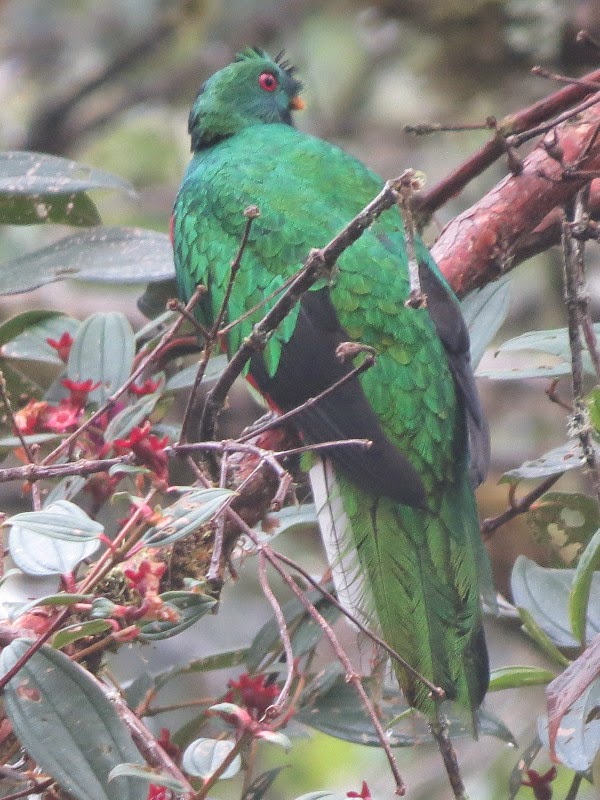
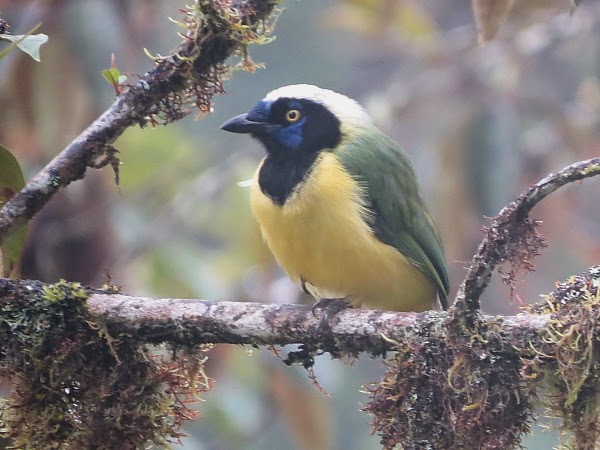
28 January.  We left Baeza at 05:00 to drive to San Isidro where we were getting a 'day pass' to use their trails.  We walked a trail in the dark to get to an area where Peruvian antpitta had been recorded the previous year but playback elicited no response. We returned to the lodge where there was lots of activity from first light with Crested Quetzal, Inca Jay and migrant Swainson's Thrush and Blackburnian and Canada Warblers.  Seven-thirty was antpitta feeding time, and this one was White-bellied, a bird I had tried very hard to see in Colombia but only managed a flight view of.  It was superb and even better brought in a fully grown juvenile, absolutely brilliant and another top target seen.  We checked out a few hummingbird feeders seeing Bronzy Inca, Fawn-breasted Brilliant, Chestnut-breasted Coronet and Long-tailed Sylph.  The rest of the day was a bit of an anticlimax.  We birded the road past San Isidro 
and a trail opposite the lodge entrance seeing Andean Guan, Merlin, White-breasted Quail-Dove, White-throated Toucanet and Dusky Piha.  Both areas were good for Black-billed Mountain Toucan but we were not fortunate.   A few km along the road there was a trail where a Barred Ant-thrush responded to playback and gave Marc a half decent view, Rod and I just seeing an ant-thrush shape.  Our attempts to pull the bird across the track failed and there was hardly anywhere where the vegetation was open enough to see the ground where one might see it coming in.  We tried clearing a small ride with no success either - very frustrating.  Returning to the lodge after dark we flushed a Rufous-banded Owl from the road while the San Isidro Black-banded Owl was calling around the lodge and gave good views from the roof, although only Marc had thought to take his camera.  A long day that started and finished very well, we returned to our hostal in Baeza, via the shops for more supplies, and the indifferent restaurant next door.


Crested Quetzal with dinky little crest
Inca Jay
White-bellied Antpitta


time to try out a new hat
juvenile
San Isidro
Cinnamon Flycatcher

Inca Jay

Chestnut-breasted Coronet
Long-tailed Sylph
squirrel
White-throated, formerly Emerald, Toucanet
Southern Lapwing


San Isidro Black-banded Owl (taken by Marc Brew as were the next two)


29 January.  We left Baeza at 06:15, 15 minutes later than intended and drove straight to the trail for the Barred Ant-thrush.  We soon got a response with the bird slowly getting closer and closer.  A movement was finally noticed behind a thick patch of vegetation.  Moving our position slightly revealed part of the bird but it was very obscured.  I kept on it barely daring to move in case it did but Marc took a chance and found a gap where the bird was in full view.  It was superb watching it but every effort into calling.  The rest of the day alternated between birding the road in the hope of a mountain-toucan and visiting Guacamayos Ridge to find it in cloud (twice).  Generally it was light showers at San Isidro and heavy showers at Guacamayos.  In the afternoon, after our second drive along the road the others decided to head back to Guacamayos.  I decided to stay and walked the best mountain-toucan stretch of the road four times over two hours seeing White-throated Toucanet (which caused a brief panic) and Andean Guan.  I then walked back towards San Isidro and was met by Gabo, Jon  and Rod.  They had seen little along the ridge, the weather still being poor, but Marc had walked the road near the lodge and seen a mountain-toucan.  We drove back to the area but no sign.  I was very gripped.  A final night in Baeza and my least favourite restaurant.
Black Agouti at San Isidro
Andean Guan
not usually this approachable!

San Isidro road mountain-toucan site, but not for me
looking towards Guacamayos ridge from San Isidro road, you can bet that by the time you got there the clouds would have rolled in

Black Phoebe


Blue & White and Southern Roughwinged Swallows
Southern Lapwing, presumably on a nest


30 January.  We packed and left Baeza soon after 06:00 driving straight to Guacamayos Ridge.  It was raining hard when we arrived, no surprise there, so we had breakfast in the car and after half an hour it eased off.  We birded along the ridge from 07:00-08:40 seeinng Yellow-bellied Chat-Tyrant and Grass-green Tanager and hearing a distant Slate-crowned Antpitta.  Gabo then drove us to Loreto stopping just outside town to look unsuccessfully for the uninspiringly named Brown-rumped Foliage-Gleaner although we may not have got the exact site.  In Loreto we met Thiery who was taking us to his lodge at Rio Bigal.
Green-banded Urania, a day flying moth